abqconcrete.com | (505) 550-0418 | Free Estimates — Albuquerque & Central New Mexico
Table of Contents
- Signs Your Albuquerque Driveway Needs Replacement — Not Repair
- Why Albuquerque Driveways Fail — The Real Reasons
- The Sub-Grade — Where Replacement Projects Succeed or Fail
- The Right Concrete Mix for Albuquerque Driveway Replacement
- Structural Reinforcement — Doing It Right This Time
- Managing the Pour and Finish in Albuquerque’s Climate
- Curing — The Step That Determines How Long It Lasts
- Areas We Serve
- 2026 Driveway Replacement Pricing in Albuquerque
- Frequently Asked Questions
- Get a Free Driveway Replacement Estimate
If your Albuquerque driveway is cracked, sunken, heaving, or falling apart — you’ve already learned the hard way what happens when concrete is installed without accounting for New Mexico’s soil conditions and climate. The good news is that driveway replacement is one of the most impactful improvements you can make to your property. The bad news is that if the replacement is done the same way as the original — same shortcuts, same inadequate mix, same poor site prep — you’ll be having this conversation again in five years.
M&M Concrete has been replacing driveways in Albuquerque for over 45 years. We’ve torn out and replaced thousands of driveways that failed because someone cut corners the first time. We know exactly why Albuquerque driveways fail — and we know how to make sure the replacement lasts 30, 40, even 50 years. Call us at (505) 550-0418 for a free replacement estimate.
Signs Your Albuquerque Driveway Needs Replacement — Not Repair
One of the most common questions we get on driveway jobs is whether the existing concrete can be patched or whether it needs full replacement. Here’s the honest answer — patching delays the inevitable when the underlying problem is structural. Here are the signs that tell us replacement is the right call:
- Cracks wider than a quarter inch. Hairline cracks are normal concrete shrinkage — they can be sealed and monitored. Cracks wider than a quarter inch indicate structural movement in the sub-grade. The concrete didn’t crack randomly — the ground moved under it. Patching a structural crack without addressing what caused it just means the patch cracks in the same place next season.
- Heaving or lifting. If sections of your driveway have lifted above adjacent sections — creating trip hazards and uneven surfaces — the sub-grade has moved. Tree roots, expansive clay soil, or poor original compaction are the usual culprits. You cannot grind or patch your way out of heaving. The cause has to be removed and the slab has to come out.
- Settling or sinking. Sections that have dropped below the surrounding grade indicate sub-grade failure — voids created by poor original compaction, root decay, or erosion during monsoon season. A sunken slab is a slab sitting on nothing in spots. Patching the surface doesn’t fix the void underneath.
- Surface spalling. Large-scale surface flaking — where the top layer of concrete is separating and falling away — indicates the concrete never reached its design strength. Too much water was added on site, curing was neglected, or the PSI was too low for Albuquerque’s freeze-thaw conditions. Once spalling starts across a large area, it accelerates. Patching buys a season at best.
- Multiple intersecting cracks. A single crack can be sealed. When cracks form a pattern — spider-webbing, diagonal cracking at corners, multiple parallel cracks — the slab is telling you the sub-grade beneath it has failed in multiple locations. That’s a replacement, not a repair.
- Drainage problems. If water is pooling on your driveway after rain or monsoons — or worse, flowing toward your garage — the original grade was wrong. You can’t re-grade a concrete slab. Replacement is the only way to fix improper drainage that’s directing water toward your structure.
📖 Further reading: Concrete Demolition and Replacement in Albuquerque — Full Guide | Our Concrete Demolition page | Our Concrete Driveways page
Why Albuquerque Driveways Fail — The Real Reasons
In 45 years of replacing failed driveways throughout Albuquerque, we’ve seen the same mistakes over and over. Understanding why your current driveway failed is the first step toward making sure the replacement doesn’t.
Inadequate Sub-Grade Compaction
This is the number one cause of driveway failure in Albuquerque. The contractor dug out the old material, dumped in some gravel, and poured concrete without properly compacting the base. Within a few years the uncompacted material settles under load — and the concrete follows it down, cracking as it goes. A driveway is only as strong as what’s under it. If the sub-grade wasn’t compacted to at least 95% Proctor density, the slab will eventually fail regardless of how good the concrete was.
Wrong Concrete Mix
Standard residential concrete in Albuquerque is often poured at 2,500 or 3,000 PSI — the minimum specification. For Albuquerque’s climate, 4,000 PSI is the appropriate standard. Lower PSI concrete is more porous, less resistant to freeze-thaw damage, and less able to handle the compressive loads of modern vehicles. If your driveway is spalling and flaking — the PSI was too low for New Mexico conditions.
Water Added to the Mix on Site
This is one of the most common and most damaging shortcuts in residential concrete work. Adding water to the mix on site makes it easier to pour and finish — but every gallon of extra water beyond the design mix weakens the final product and increases shrinkage cracking. A properly specified 4,000 PSI mix that gets watered down on site might cure out at 3,000 PSI or less. We never add site water to our mixes.
Missing or Incorrectly Placed Rebar
Wire mesh sitting on the ground provides almost no tensile reinforcement. Rebar placed without chairs ends up on the dirt rather than suspended in the middle of the slab. Either way, the concrete has no tensile resistance when the ground shifts. The slab cracks and the two sections move independently — creating the offset cracking and trip hazards that are the most visible signs of reinforcement failure.
No Control Joints or Incorrectly Placed Joints
Control joints tell concrete where to crack — at the bottom of the joint, invisibly, in a straight line. Without properly placed control joints cut to the right depth, thermal shrinkage cracks form randomly across the slab surface. We see driveways in Albuquerque with no control joints at all — the contractor just poured a solid slab and let nature decide where it cracked. Nature never decides well.
Root Intrusion
Albuquerque neighborhoods with mature Cottonwoods, Elms, and Mulberries are driveway replacement hotspots. Root systems grow under slabs, lifting and cracking them as the roots expand. When we replace driveways in established neighborhoods — the North Valley, Northeast Heights, Four Hills — root management is often one of the first things we address. Replacing the slab without removing the roots means the replacement fails for the same reason the original did.
Poor Original Drainage Design
A driveway that slopes toward the garage or has low spots that collect water is a driveway that’s constantly fighting moisture intrusion, freeze-thaw damage, and sub-grade saturation during monsoon season. Fixing the drainage requires replacement — you can’t re-grade existing concrete.
📖 Further reading: Why Quality Site Prep Matters for Every Concrete Project | Your Guide to a Long-Lasting Concrete Driveway in Albuquerque
The Sub-Grade — Where Replacement Projects Succeed or Fail
A driveway replacement is an opportunity to fix everything that was wrong with the original installation. The most important of those fixes happens before any concrete is poured — in the sub-grade preparation. Here’s exactly how we approach it:
Demolition and Removal
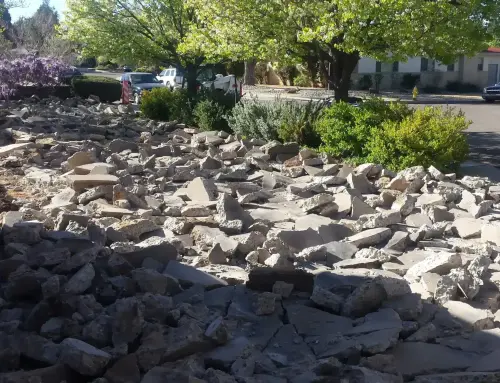
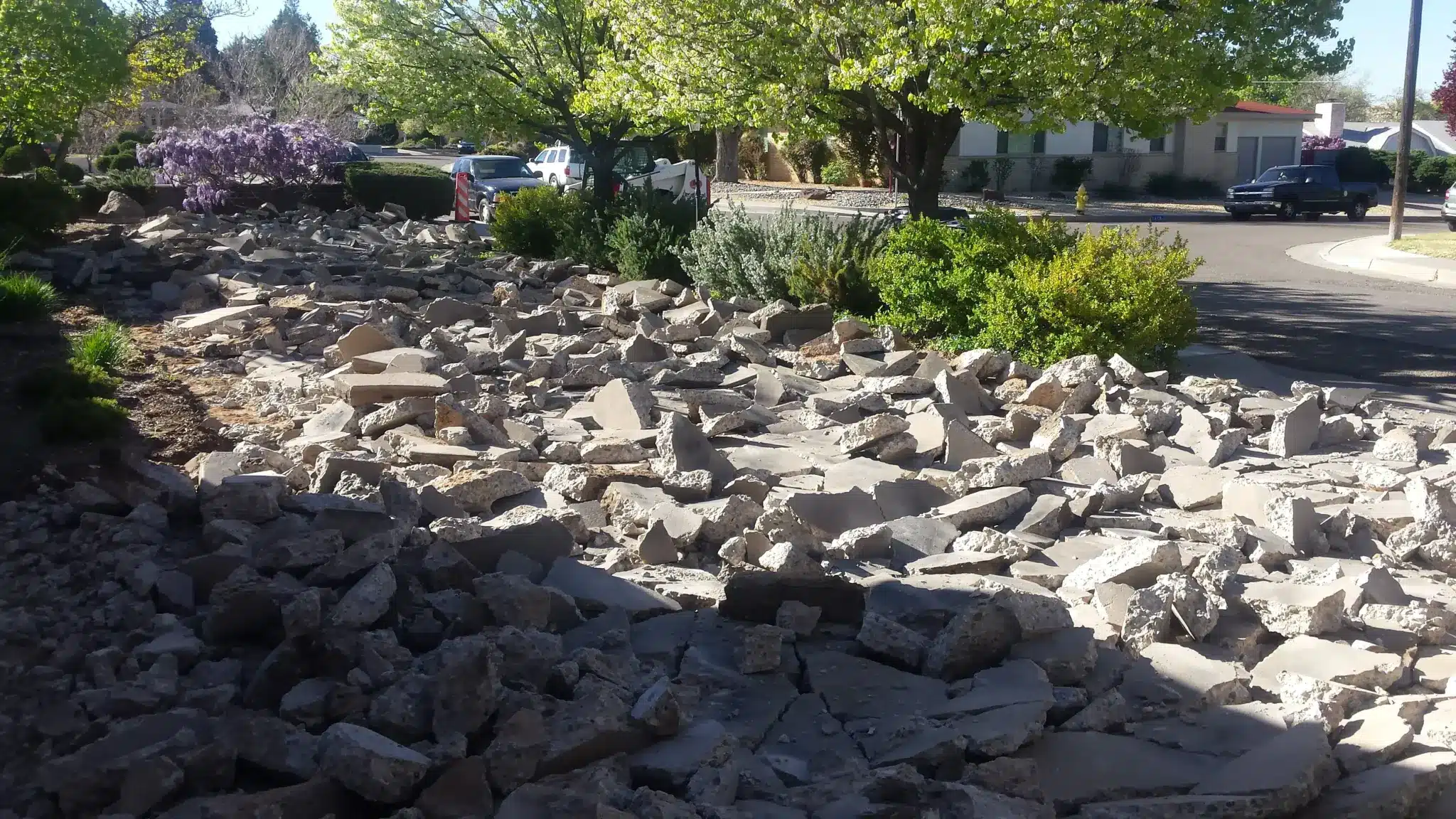
We break up and remove the existing concrete using our own backhoe and Bobcat equipment. The old concrete is hauled away — we don’t crush it in place as a sub-base unless the project specifically calls for it and the material is suitable. Starting with a clean excavation gives us the ability to assess and address what actually caused the original failure.
Root Removal
Every significant root system near the excavation gets removed — completely. We’ve seen contractors grind the surface roots and leave the deep ones, only to have the replacement heave within two years as the remaining roots continue to grow. We remove roots to the point where they can no longer affect the slab. In extreme cases we apply root barrier treatment to prevent regrowth into the sub-grade area.
Soil Assessment
Once we’re down to sub-grade, we assess what’s there. Clay pockets get removed and replaced with compacted base material. Caliche is evaluated — solid consistent caliche is a good bearing layer, irregular caliche gets broken through to stable soil below. Soft spots get addressed before a single cubic yard of concrete is ordered.
Base Course Installation
A minimum 4-inch layer of crushed gravel base course goes in after the sub-grade is prepared. This provides a stable, level, well-draining platform for the concrete pour. It acts as a structural bridge between the soil and the slab, and provides drainage that prevents moisture from pooling directly under the concrete — critical during Albuquerque’s monsoon season.
Mechanical Compaction
We compact the base in layers using vibratory equipment — not a hand tamper. The goal is a minimum of 95% Proctor density. If the dirt moves, the concrete breaks. Compaction is the step that prevents that. We verify it before we form anything.
The Right Concrete Mix for Albuquerque Driveway Replacement
Your replacement driveway deserves better than whatever went in the first time. Here’s how we specify concrete for driveway replacement in Albuquerque:
4,000 PSI Minimum
4,000 PSI is the professional benchmark for residential driveways in New Mexico — not 2,500 or 3,000 PSI. The higher compressive strength provides better resistance to the weight of modern vehicles, better freeze-thaw performance, and better durability under Albuquerque’s UV exposure and temperature swings. The cost difference between 3,000 and 4,000 PSI concrete is modest. The performance difference over 20 years is significant.
Low Water-Cement Ratio
We don’t add water on site. The mix leaves the plant at the specified water-cement ratio and stays that way. If the concrete needs to be workable in Albuquerque’s heat, we use superplasticizers — chemical admixtures that improve workability without adding water and without sacrificing strength. This is how professional concrete work is done. Adding a hose to the truck is how you get a weak slab.
Air Entrainment
Air-entrained concrete contains microscopic air bubbles that act as pressure relief valves during freeze-thaw cycles. When water inside the concrete freezes and expands, those bubbles give it somewhere to go — instead of spalling the surface. We use air-entrained mixes on every driveway replacement in Albuquerque. If your original driveway was poured without air entrainment and you’re above 5,000 feet elevation, that’s likely a contributing factor to your surface spalling.
Synthetic Fiber Reinforcement
We integrate synthetic fiber reinforcement throughout the mix to provide three-dimensional secondary reinforcement — catching micro-cracks before they become visible surface cracks. Combined with rebar, fiber reinforcement gives the replacement slab significantly better crack resistance than the original likely had.
Structural Reinforcement — Doing It Right This Time
If your original driveway had wire mesh sitting on the ground — or no reinforcement at all — the replacement is going to be a significant upgrade in structural performance. Here’s how we reinforce driveway replacements:
- #3 or #4 deformed steel rebar on 16 to 18-inch centers for standard residential driveways. #4 or #5 on tighter spacing for heavy-load applications — RV parking, heavy truck access, oversized driveways.
- Properly chaired rebar. Rebar placed on chairs or dobies is suspended in the middle third of the slab — where it actually provides tensile strength. Rebar sitting on the ground provides almost no structural benefit. We chair every bar on every pour.
- Correct lap splices and corner reinforcement. Corners are where driveways crack first under thermal stress. We lap rebar at corners and place diagonal bars at reentrant corners — the weak points that most contractors ignore.
Managing the Pour and Finish in Albuquerque’s Climate
Albuquerque’s low humidity, high UV exposure, and afternoon winds create a challenging environment for concrete placement. Managing the pour correctly in these conditions is where experience makes a real difference:
Early Morning Pours
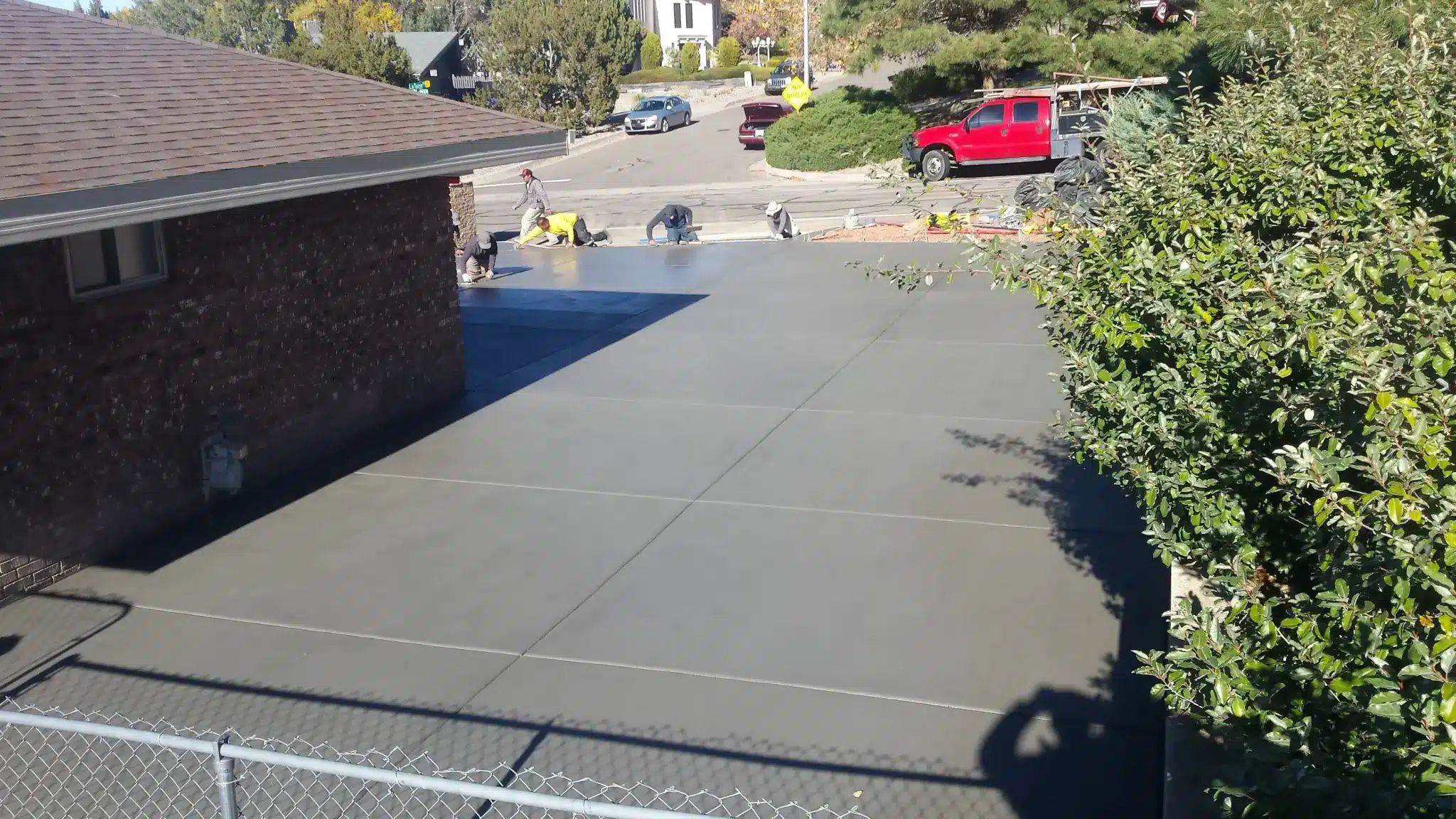
We schedule driveway replacements to begin at first light — before the sun and heat accelerate surface evaporation. In summer months this means crews on site before 6 AM on large replacement projects. Pouring in full afternoon sun in Albuquerque is a recipe for plastic shrinkage cracks — the surface dries before the interior sets and spiderweb cracks appear within hours of placement.
Evaporation Retardants
In high-wind or high-temperature conditions we apply evaporation retardants to the fresh concrete surface — specialized treatments that slow moisture loss without affecting the finishing process. This buys critical time between placement and finishing in Albuquerque’s dry air.
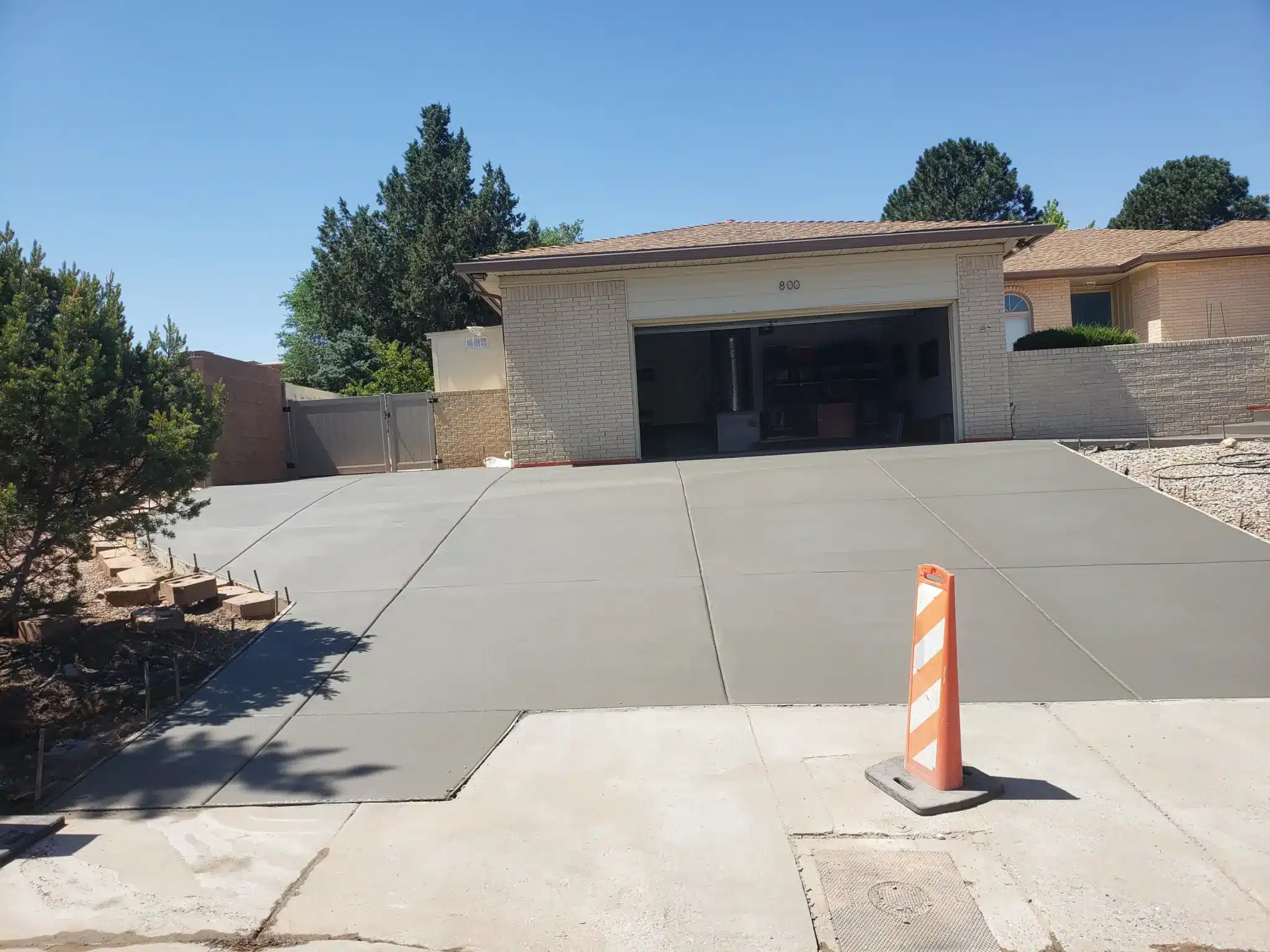
Broom Finish
A medium broom finish is standard for driveway replacements — it provides the slip resistance needed for vehicle and foot traffic while creating a clean, professional appearance. Heavier broom textures are available for steep driveways where additional traction is needed in wet or icy conditions.
Alternative Custom Concrete Finishes
A driveway replacement is the perfect opportunity to upgrade your finish. If you’ve always wanted a more decorative look — now is the time, since the demo and base prep costs are already part of the project. We offer several decorative options as alternatives to a standard broom finish:
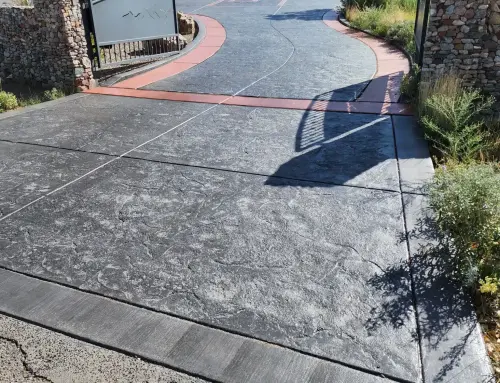
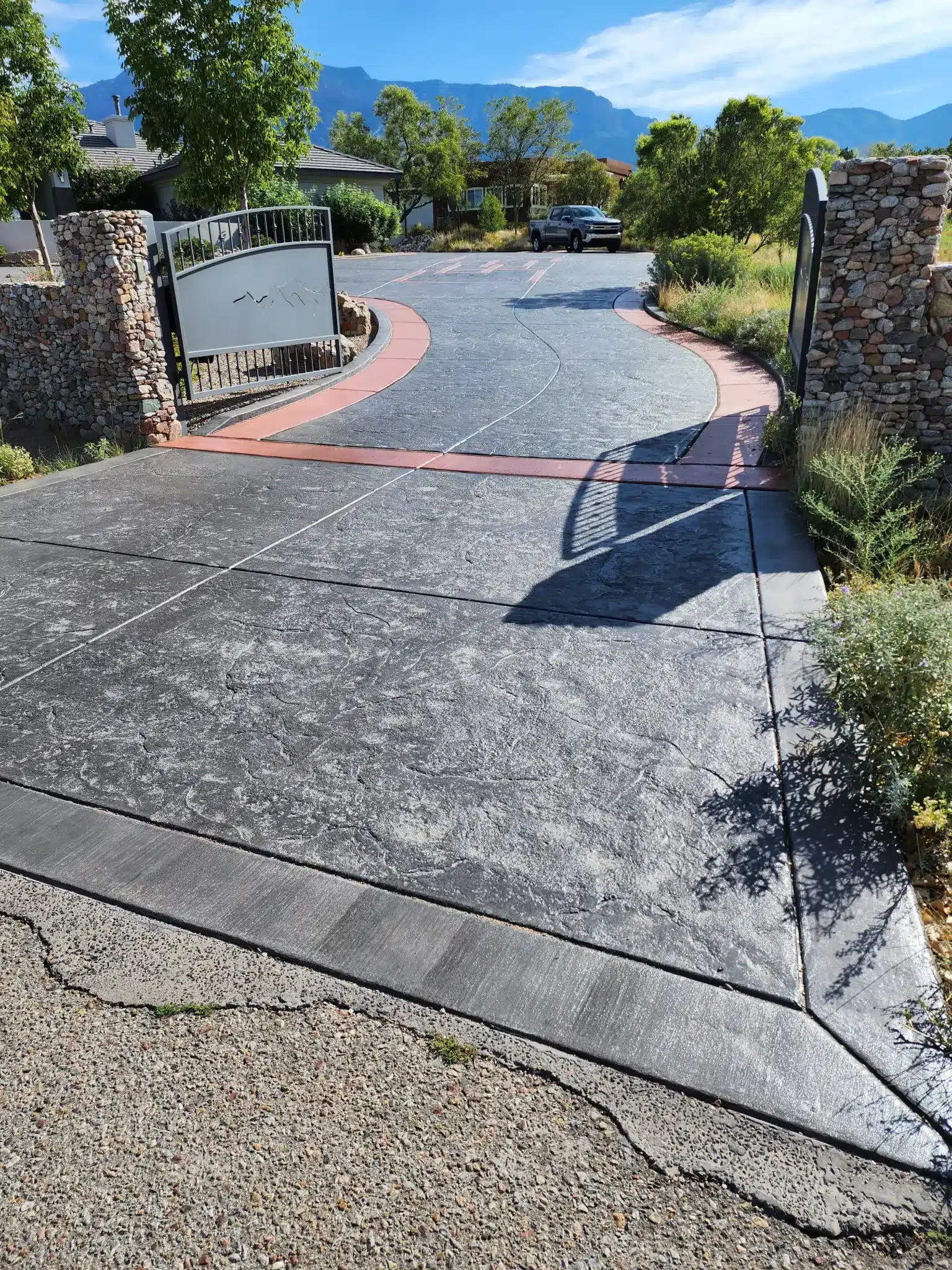
- Stamped concrete — Flagstone, Ashlar slate, cobblestone, wood plank, and brick patterns in colors that complement your home’s architecture. A stamped driveway replacement gives you the look of natural stone at a fraction of the cost. See our stamped concrete service page.
- Exposed aggregate — A textured finish that exposes the stone aggregate in the concrete mix. Extremely durable, slip-resistant, and looks great in Albuquerque’s Southwest landscape.
- Colored concrete — Integral color added to the mix gives your replacement driveway a custom look that coordinates with your home’s exterior without the additional labor of stamping.
📖 Further reading: Stamped Concrete Patios and Driveways Albuquerque — Design Ideas & Pricing | Stamped Concrete Contractors Albuquerque | Our Concrete Driveways Service Page
Control Joints — Telling the Concrete Where to Crack
All concrete cracks as it cures and as it undergoes thermal expansion and contraction. Control joints are deep grooves cut or formed into the slab that create weakened planes — so when the slab shrinks, the crack happens at the bottom of the joint, invisible from the surface. We cut control joints at every 8 to 10 feet on driveway replacements and at every reentrant corner. Joint depth is at least one-quarter the slab thickness. No exceptions.
Curing — The Step That Determines How Long It Lasts
Albuquerque’s dry air is the enemy of proper concrete curing. The chemical reaction that hardens concrete — hydration — requires moisture. In our low-humidity environment, that moisture evaporates from the surface within hours of placement if it isn’t retained. A slab that loses moisture too fast never achieves its design strength — regardless of how good the mix specification was.
We apply curing compounds immediately after finishing on every driveway replacement. The curing compound creates a membrane that traps moisture in the slab during the critical first 72 hours. On high-value or large-scale replacement projects, we supplement with wet curing — keeping the surface moist through the initial cure period. Proper curing management can increase final concrete strength by up to 50% compared to an uncured slab with the same mix design. Most contractors finish and leave. We finish and cure.
Usage Timeline After Replacement
- 24 to 48 hours — Walking on the surface is fine.
- 7 days — Standard passenger vehicles. We recommend waiting the full 7 days even though the slab will feel hard sooner — full structural strength takes time.
- 28 days — Heavy vehicles — RVs, loaded trucks, heavy equipment. Full design strength (4,000+ PSI) is reached at 28 days. Loading before that risks surface damage from point loads.
Areas We Serve — Driveway Replacement in Albuquerque and Central NM
We replace driveways throughout the Albuquerque metro and central New Mexico. Each area presents its own soil and climate challenges that we account for in every replacement project:
- Albuquerque — All Neighborhoods — Northeast Heights, North Valley, South Valley, Four Hills, the Heights, Nob Hill, Westside. We know the soil conditions neighborhood by neighborhood.
- North Albuquerque Acres & Sandia Foothills — Large driveways on granite terrain. Root management often needed from mature landscaping. High-load applications common for large homes.
- North Valley & Corrales — Cottonwood root intrusion is extremely common in established North Valley driveways. We address roots completely before replacement — not partially.
- PAAKO, Placitas & Bernalillo — Rural and custom estate driveways. Long driveways requiring careful joint planning and drainage design.
- Rio Rancho — Sandy soils require heavy compaction. Many Rio Rancho driveways from the early 2000s building boom are now reaching replacement age.
- Santa Fe — Freeze-thaw cycles are more severe. Air-entrained mix and deeper joint cuts are standard on all Santa Fe replacements.
- Edgewood & East Mountains — Rocky terrain and serious freeze-thaw conditions. Steep driveways requiring drainage planning and heavier texture finish for traction.
- Los Lunas & Valencia County — Rio Grande valley soils with clay content. Drainage and base prep are critical on every replacement.
2026 Driveway Replacement Pricing in Albuquerque
Driveway replacement pricing includes demolition of the existing slab, haul-off, sub-grade preparation, base course, forming, reinforcement, pour, finish, and sealing — the complete scope. Here’s what to expect in the Albuquerque market in 2026:
| Driveway Size | Sq Ft | Demo + Replace Cost |
|---|---|---|
| Single car driveway | ~400 sq ft | $3,500 – $6,500 |
| Double car driveway | ~600 sq ft | $5,000 – $9,500 |
| Large / extended driveway | ~1,000 sq ft | $8,000 – $15,000 |
| RV or oversized driveway | ~1,500+ sq ft | $12,000 – $22,000+ |
| Concrete demolition only | Per sq ft | $2 – $6 |
| Concrete haul-off | Per load | $500 – $850 |
| Root removal (significant) | Per project | $500 – $2,500 |
| Caliche removal | Varies | $500 – $2,500 |
| Stamped / decorative replacement | Per sq ft | $12 – $25 |
These are real numbers for complete driveway replacement in Albuquerque — not per-square-foot concrete-only quotes that leave demo, haul-off, and base prep as hidden extras. When M&M Concrete quotes a driveway replacement, the quote covers the complete scope. No surprises after you sign.
📖 For complete pricing on all concrete services: Concrete Contractor Costs in Albuquerque — Full 2026 Price Guide
Frequently Asked Questions — Driveway Replacement Albuquerque
How do I know if my driveway needs replacement or just repair?
Repair is appropriate for isolated surface cracks under a quarter inch wide and minor surface scaling in limited areas. Replacement is the right call when you have cracks wider than a quarter inch, heaving or sinking sections, widespread spalling, drainage problems, or multiple intersecting cracks that indicate sub-grade failure. Patching structural problems delays the inevitable — and every season you wait the underlying cause gets worse.
How long does a driveway replacement take in Albuquerque?
Demolition and haul-off typically happens on day one. Sub-grade preparation and forming on day two. The pour and finish on day three in most cases. You can walk on the new surface within 24-48 hours of the pour. Vehicle traffic after 7 days. Heavy vehicles — RVs, loaded trucks — after 28 days. Total project time from first day to driving on it is typically 10 to 14 days including scheduling and weather windows.
Should I replace my driveway with concrete or asphalt?
Concrete is the better long-term investment in Albuquerque. Asphalt costs less upfront but softens in Albuquerque’s summer heat, requires sealing every 3-5 years, and lasts 20-25 years versus concrete’s 30-50 years. The ongoing maintenance cost of asphalt typically exceeds concrete’s higher upfront cost within 15 years. In New Mexico’s climate — intense UV, high heat, and freeze-thaw cycles at elevation — concrete outperforms asphalt significantly over the life of the driveway.
What causes driveways to crack in Albuquerque so fast?
The most common causes are inadequate sub-grade compaction, low-PSI concrete mix, water added to the mix on site, missing or incorrectly placed rebar, no control joints, root intrusion from nearby trees, and poor drainage design. All of these are preventable. They’re also the exact reasons most Albuquerque driveways that fail prematurely do so — and the exact mistakes we’ve been fixing for 45 years.
How much does it cost to replace a driveway in Albuquerque?
A complete driveway replacement — demolition, haul-off, sub-grade prep, base course, pour, finish, and seal — runs $5,000 to $9,500 for a standard two-car driveway (600 sq ft) in Albuquerque in 2026. Larger driveways, root removal, caliche, or decorative finishes add cost. See our complete 2026 pricing guide for detailed breakdowns.
Can you replace just part of my driveway?
In some cases — yes. If a section has failed while the rest is structurally sound, partial replacement is possible. The challenge is matching the color and texture of existing concrete — new concrete is always lighter than aged concrete and the difference is visible. We assess every situation honestly and tell you whether partial or full replacement makes more sense for your specific driveway.
Do I need a permit to replace my driveway in Albuquerque?
A driveway approach — where the driveway connects to the public street — typically requires a permit from the City of Albuquerque. In-property driveway replacement generally doesn’t require a permit. We help our clients understand the permitting requirements for their specific project before we start work.
How do I get a free driveway replacement estimate from M&M Concrete?
Call us at (505) 550-0418 or request an estimate online at abqconcrete.com. We come out, assess your existing driveway, identify what caused the failure, and give you a written quote covering the complete replacement scope. No pressure, no gimmicks — just an honest assessment and a straight number from a contractor who has been replacing Albuquerque driveways for 45 years.
Get a Free Driveway Replacement Estimate in Albuquerque
Your driveway is going to be replaced. The only question is whether you replace it now — on your terms, with the right contractor — or wait until it becomes a safety hazard and an eyesore that’s affecting your property value. Either way, the replacement is coming.
When you’re ready to do it right — with proper sub-grade preparation, 4,000 PSI concrete, correctly chaired rebar, properly placed control joints, and professional curing management — call the crew that’s been doing driveway replacement in Albuquerque for 45 years.
We’ve fixed enough bad driveways to know exactly how to make sure yours doesn’t become one.
M&M Concrete. Locally owned. Family operated. 45+ years and still pouring.
Call us today: (505) 550-0418
Or request a free estimate online at abqconcrete.com.
abqconcrete.com | (505) 550-0418 | Serving Albuquerque, Rio Rancho, Santa Fe, Los Lunas, Edgewood, Corrales, Placitas, North Albuquerque Acres & all of Central New Mexico