abqconcrete.com | (505) 550-0418 | Free Estimates — Albuquerque & Central New Mexico
Table of Contents
- The Foundation of the Foundation — Soil Mechanics in the High Desert
- The Chemistry of the Mix — Beyond Standard Concrete
- Structural Reinforcement — The Skeleton of the Slab
- The Pour and the Finish — Managing New Mexico’s Elements
- Curing — The Step Most Contractors Skip
- Our Concrete Installation Services in Albuquerque
- Areas We Serve
- 2026 Concrete Installation Pricing in Albuquerque
- Frequently Asked Questions
- Get a Free Estimate
In the concrete industry, there is a massive gap between doing a job and engineering a solution. In the high desert of New Mexico — across Bernalillo, Sandoval, Santa Fe, and Valencia counties — this gap is the difference between a slab that lasts fifty years and one that begins to fail within twenty-four months.
When you are investing in a 40′ x 70′ metal building foundation in Bosque Farms or an 11,000-square-foot driveway in North Albuquerque Acres, you aren’t just buying a surface. You are buying a structural system. M&M Concrete has been engineering and installing concrete throughout Albuquerque and central New Mexico for over 45 years. This guide breaks down the technical requirements for concrete installation that stands the test of time in our unique environment. Call us at (505) 550-0418 for a free estimate.
The Foundation of the Foundation — Soil Mechanics in the High Desert
The most common cause of concrete failure in Albuquerque isn’t the concrete itself — it’s the dirt underneath. Our region presents a geological combination that can be treacherous for the uninformed contractor. You cannot treat all Albuquerque soils the same way — and after 45 years working this ground, we know exactly what each area requires.
Caliche and Sandy Loam — West Mesa and Rio Rancho
On the West Mesa and through parts of Rio Rancho, we deal with sandy loam and caliche — a hardened layer of calcium carbonate. Sandy loam looks stable but compacts poorly if not properly moisture-conditioned and mechanically compacted. Caliche can be a good bearing layer when it’s solid and level — but when it’s irregular it creates hard spots that cause differential settling and cracking. We assess caliche depth on every job and factor it into your quote upfront. No mid-project surprises.
Silty and Organic Soils — North Valley and South Valley
In the North Valley and South Valley, we deal with high water tables and silty, organic soils deposited by the Rio Grande over centuries. These soils have poor bearing capacity and high moisture content. Organic material buried under a slab will eventually decay, creating subterranean voids. Under the weight of a reinforced slab, those voids lead to localized settlement cracking. We remove all organic material before any pour in valley areas — completely, not partially.
The Three Steps We Never Skip
- Grubbing and clearing. Every project begins with the total removal of organic material — roots, vegetation, buried debris. If a contractor pours over root systems, that material decays and creates voids under the slab. We’ve seen it fail in less than two years. We clear completely before we form anything.
- Moisture conditioning. You cannot compact bone-dry New Mexico dirt. To reach the required density, the subgrade must be moisture-conditioned — we apply water to reach the optimum moisture content, allowing soil particles to lock into a tight, interlocking matrix during compaction.
- Mechanical compaction. A hand-plate tamper is not adequate for a structural slab. We use heavy vibratory equipment to ensure the subgrade meets a minimum of 95% Proctor density. If the dirt moves, the concrete breaks. It is that simple.
📖 Further reading: Why Quality Site Prep Matters for Every Concrete Project | ABQ Backhoe & Bobcat Services — Site Preparation
The Chemistry of the Mix — Beyond Standard Concrete
In Albuquerque, we face extreme temperature swings — sometimes 50 degrees within a single day. This creates massive internal stress in concrete. To combat this, the chemical composition of the mix must be engineered for the specific application and the specific climate. Most contractors in Albuquerque use whatever mix the ready-mix plant sends. We specify the mix for every job.
PSI and Water-Cement Ratios
Most standard contractors use a 3,000 PSI mix — the bare minimum for residential work. At M&M Concrete we use a 4,000 PSI standard for driveways and shop floors. Here’s why that matters:
- 4,000 PSI offers significantly higher compressive strength and better resistance to the freeze-thaw cycles Albuquerque experiences every winter — especially at elevations above 5,000 feet.
- Water-cement ratio is the most abused variable on most job sites. Adding water on site makes concrete easier to pour and finish — but every gallon of water added beyond the design mix weakens the final product and increases shrinkage cracking. We maintain a low water-cement ratio on every pour. We don’t add site water to make finishing easier.
Additives — Fiber and Air Entrainment
In New Mexico’s climate, two additives are non-negotiable on structural pours:
- Air-entraining admixtures create billions of microscopic bubbles in the concrete that act as pressure relief valves when moisture inside the concrete freezes and expands. Without air entrainment, the surface of your concrete will eventually spall — flake off in chunks — after repeated freeze-thaw cycles. This is especially critical at Santa Fe’s elevation and in the East Mountains.
- Synthetic fiber reinforcement integrated throughout the mix provides three-dimensional secondary reinforcement — catching micro-cracks before they become visible surface cracks. Combined with rebar, fiber reinforcement gives a structural slab significantly better crack resistance than either material alone.
Structural Reinforcement — The Skeleton of the Slab
Concrete is incredibly strong in compression — pushing down — but it is weak in tension — pulling apart. In Albuquerque’s shifting soils, tension is inevitable. Clay soils expand and contract. Sandy soils settle. Caliche creates hard spots. Without proper reinforcement, your slab cracks when the soil moves beneath it. With proper reinforcement, it spans those movements and stays intact.
Rebar vs. Wire Mesh
Wire mesh — 6×6 welded wire fabric — is common on residential pours because it’s cheap and fast to install. But wire mesh has a fundamental problem: it almost always ends up sitting on the ground rather than suspended in the middle of the slab where it actually provides tensile strength. Rebar, when properly chaired, stays in position throughout the pour. We use deformed steel rebar on structural pours — not wire mesh.
Rebar Schedules for Albuquerque Conditions
- Heavy-duty shop floors and large driveways — #4 or #5 rebar on 12″ to 16″ centers. This provides the tensile strength necessary to span minor soil movements without cracking.
- Chairing the steel — Rebar sitting on the dirt does nothing. We use chairs or dobies to suspend the steel in the middle third of the slab. This ensures the rebar is fully encapsulated in concrete and positioned to resist the tensile forces that cause cracking.
- Lap splices and corners — Rebar connections at corners and lap splices are done to ACI standards. A corner without proper rebar lapping is the first place a slab cracks under thermal stress.
The Pour and the Finish — Managing New Mexico’s Elements
The window between concrete leaving the truck and final set is the most critical time in the life of any project. In the high desert, our low humidity, high UV exposure, and frequent winds are the enemies of quality concrete. Managing the pour correctly in these conditions is where 45 years of Albuquerque experience makes a real difference.
Preventing Plastic Shrinkage Cracks
If the surface of the concrete dries faster than the bottom — which happens constantly in Albuquerque’s low-humidity environment — you get spiderweb cracks within hours of the pour. These surface cracks are not just cosmetic — they’re entry points for moisture, freeze-thaw damage, and long-term deterioration. We manage this through:
- Early starts — Scheduling pours during the coolest part of the day to stay ahead of the sun and reduce surface evaporation rate.
- Evaporation retardants — In high-wind or high-temperature conditions, we apply specialized surface treatments that prevent moisture from escaping the fresh concrete surface too quickly.
- Shade and wind protection — On exposed sites we use windbreaks and shade when conditions demand it.
Control Joints — Designing Where the Crack Goes
All concrete will crack eventually. The goal is to control where it cracks. We install deep control joints — at least one-quarter the depth of the slab — in strategic locations across every pour. This creates a weakened plane so that when the slab undergoes thermal shrinkage, the crack happens neatly at the bottom of the joint — invisible from above and structurally managed. A contractor who doesn’t place control joints correctly is leaving crack location up to chance. We never leave it up to chance.
Curing — The Step Most Contractors Skip
Most contractors finish the concrete and leave the job site. This is one of the most common and most costly mistakes in residential concrete work in Albuquerque. Concrete does not dry — it cures through a chemical process called hydration. If water leaves the slab too fast, the chemical bond is never fully realized and the concrete never reaches its design strength.
In Albuquerque’s dry air, moisture can leave fresh concrete within hours of placement — long before the hydration reaction is complete. Proper curing management — whether through chemical curing compounds or wet curing methods — keeps moisture in the slab for the critical first 72 hours. Done correctly, proper curing can increase the final strength of the concrete by up to 50% compared to an uncured slab poured with the same mix design.
We apply curing compounds on every pour. On critical structural pours — foundations, large slabs, high-value decorative work — we use wet curing methods as well. We don’t finish and walk away. The pour isn’t done until the curing is managed.
Our Concrete Installation Services in Albuquerque
We apply the engineering standard described above to every concrete project we take on — regardless of size or scope. Here are the specific services we provide throughout Albuquerque and central New Mexico:
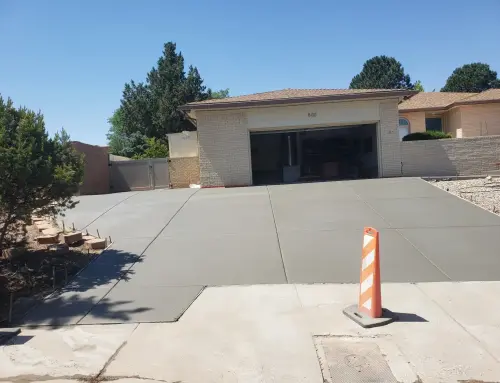
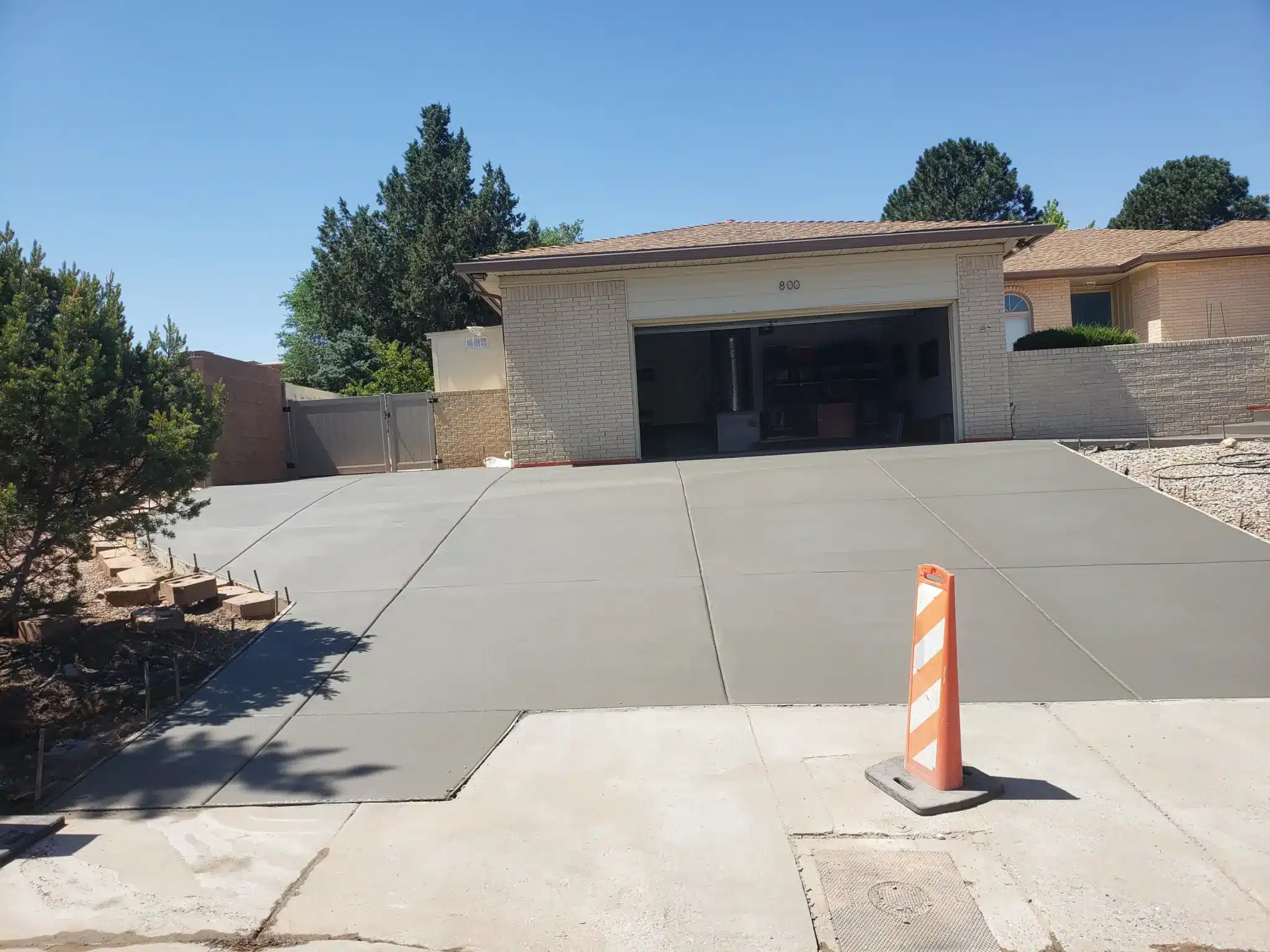
🚗 Concrete Driveways — Albuquerque
A properly installed concrete driveway in Albuquerque lasts 30-50 years. We design every driveway to the correct PSI, thickness, and rebar schedule for the specific soil conditions and vehicle loads on your property. Proper base prep, expansion joints, and sealing are included on every driveway we pour.
→ Visit our Concrete Driveways page
📖 Further reading: Your Guide to a Long-Lasting Concrete Driveway | The Best Time to Repave Your Driveway
🏗️ Concrete Foundations — Albuquerque
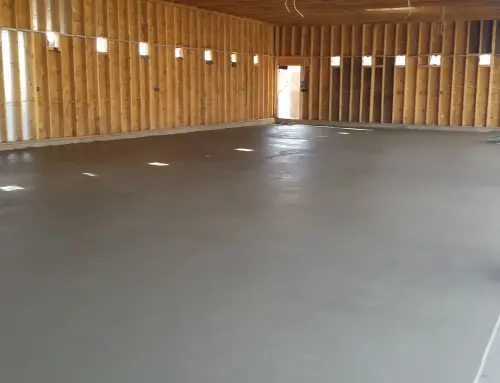
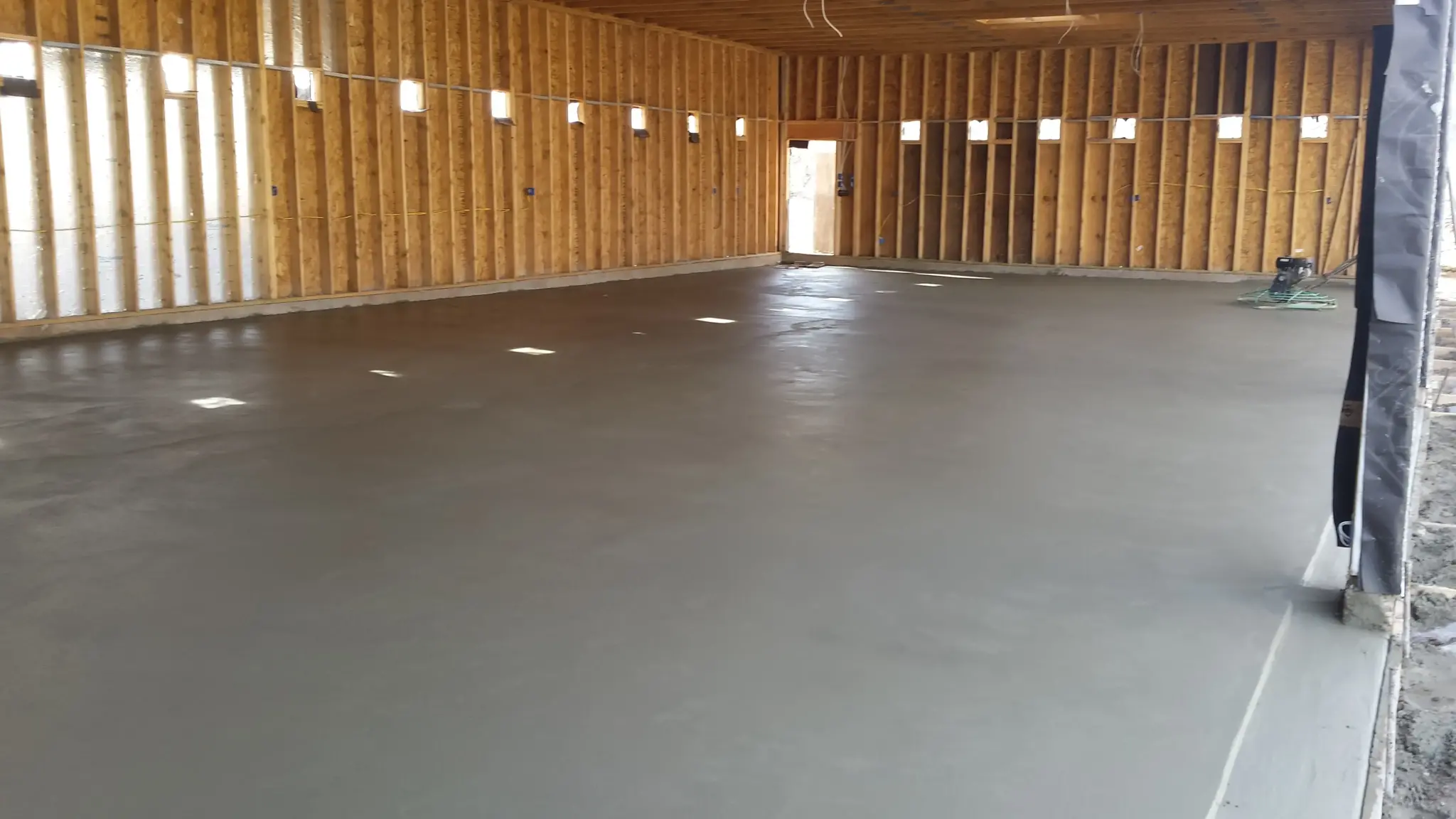
Foundations are the most critical concrete pour on any project. We install monolithic slabs, stem wall foundations, garage slabs, metal building foundations, and home addition foundations — all engineered for Albuquerque’s specific soil conditions, frost depth requirements, and load demands.
→ Visit our Concrete Foundations page
📖 Further reading: Concrete Foundations in Albuquerque NM — Complete Guide
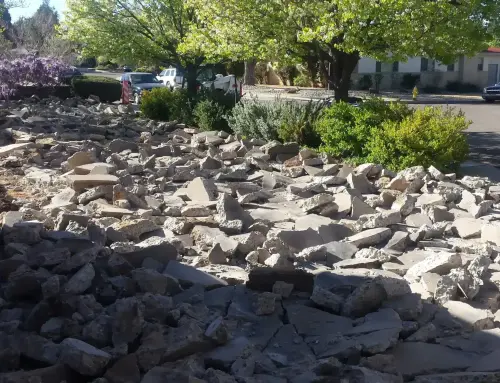
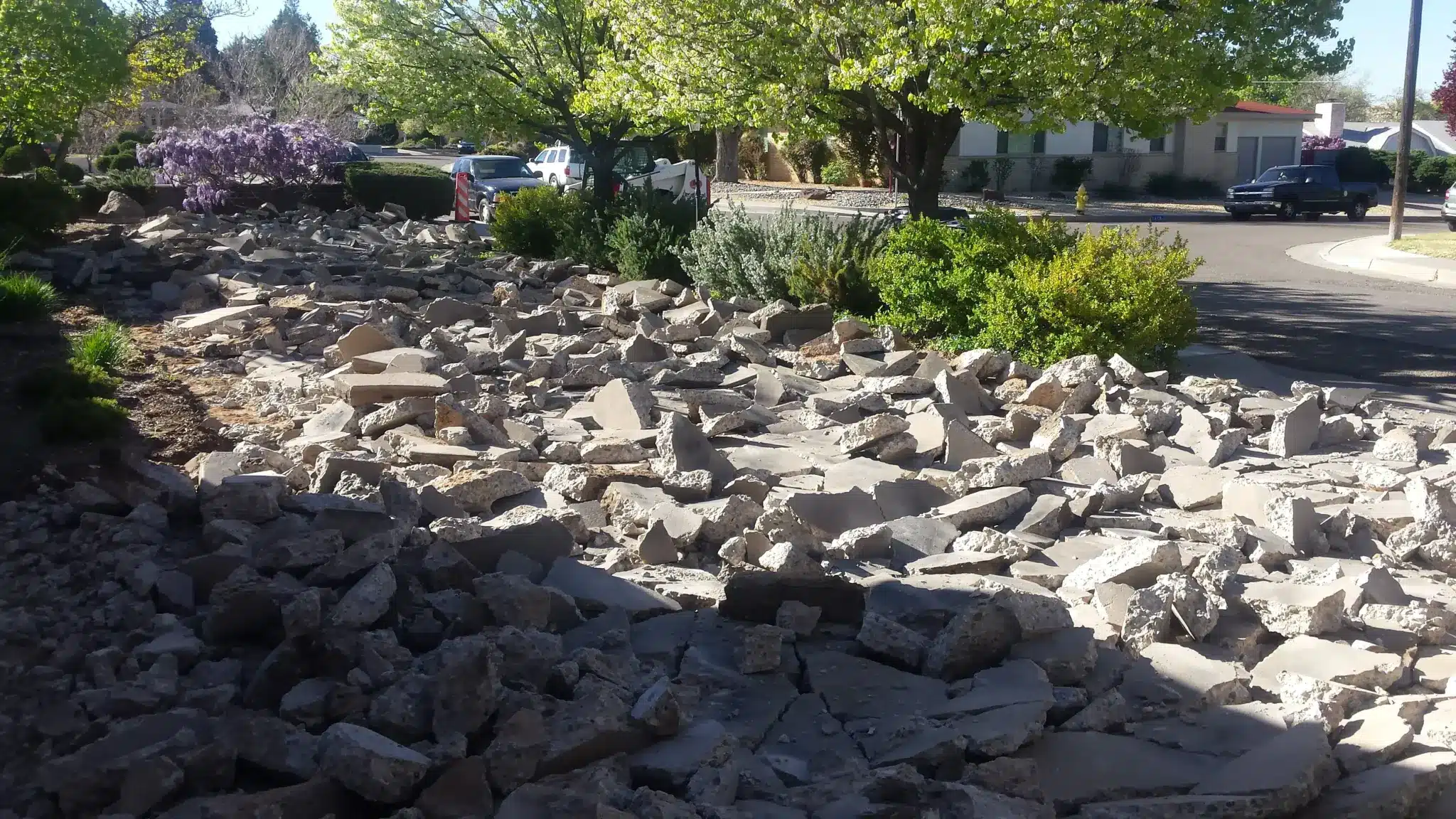
💥 Concrete Demolition and Removal — Albuquerque
Before new concrete goes in, old concrete often has to come out. We handle demolition and removal with our own equipment — breaking up existing slabs, hauling debris, and prepping the site for a new pour. No subcontractors, no delays between demo and pour.
→ Visit our Concrete Demolition page
📖 Further reading: Concrete Demolition and Replacement in Albuquerque — Full Guide
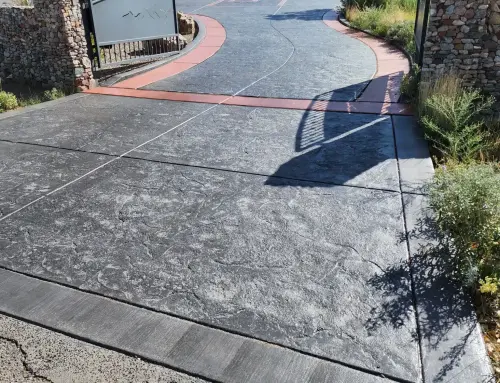
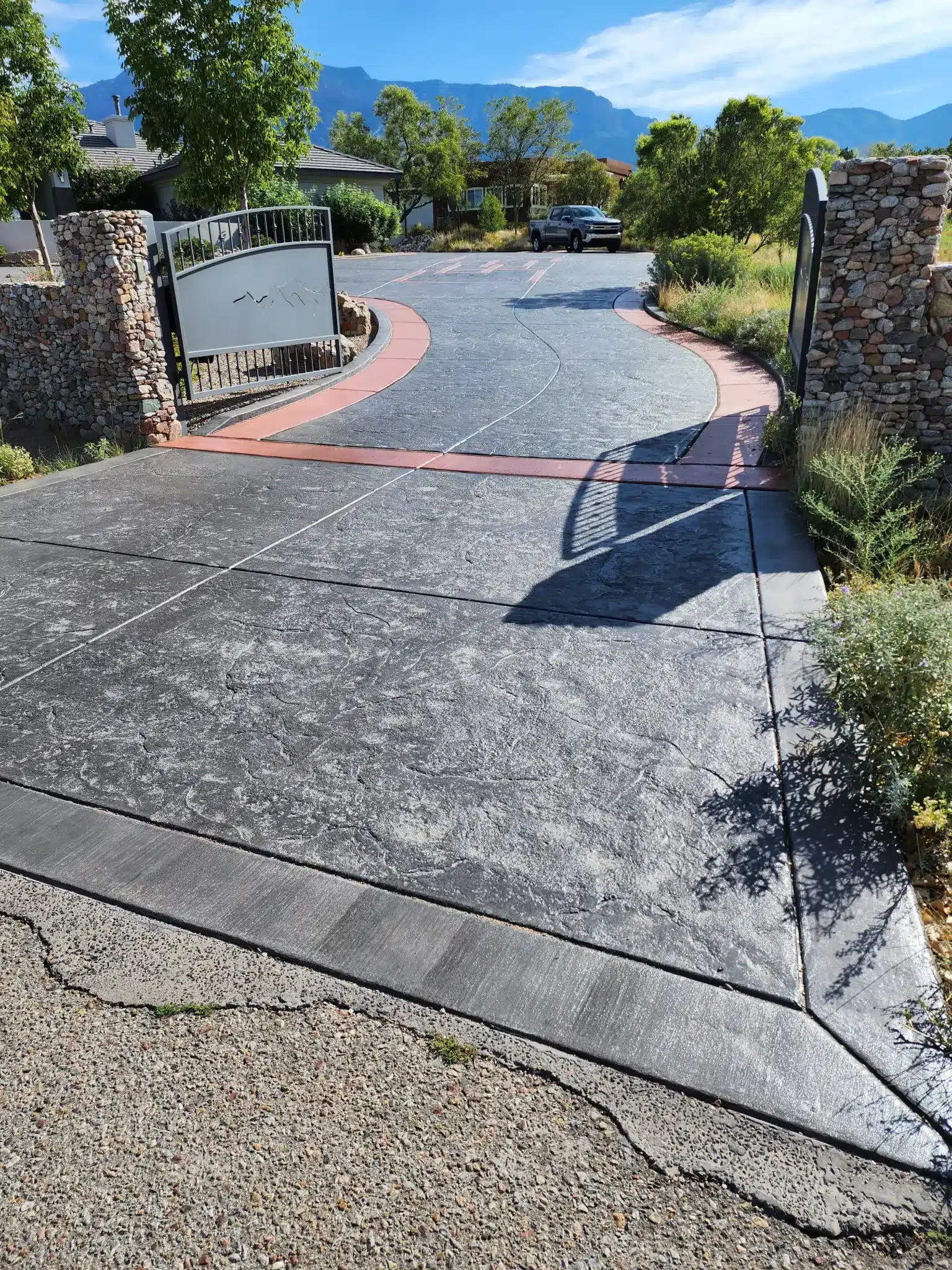
🎨 Stamped and Decorative Concrete — Albuquerque
Stamped concrete requires all the same engineering discipline as structural concrete — plus the timing precision to stamp the surface at exactly the right moment. We’ve been doing stamped concrete in Albuquerque’s summer heat for 45 years. We know the window and we hit it every time.
→ Visit our Stamped Concrete page
📖 Further reading: Stamped Concrete Patios and Driveways Albuquerque | Stamped Concrete Contractors Albuquerque
🚜 Bobcat and Backhoe Services — Albuquerque
Great concrete starts with great site prep. Our subsidiary ABQ Backhoe & Bobcat Services handles all excavation, grading, compaction, demolition, land clearing, trenching, and haul-off — in house with our own equipment and operators. The same crew that preps your site pours your concrete.
→ Visit our Bobcat and Backhoe Services page
📖 Further reading: Why Quality Site Prep Matters for Every Concrete Project
🌵 Santa Fe Concrete Foundations & Services
Santa Fe sits at 7,000 feet with more severe freeze-thaw cycles than Albuquerque. Footings go deeper, mix designs require air entrainment, and curing management is even more critical. We’ve been installing concrete foundations and performing all concrete services in Santa Fe for 45 years.
→ Visit our Santa Fe Concrete Foundations page
📖 Further reading: Santa Fe Concrete Contractors — Complete 2026 Guide
🏙️ Rio Rancho Concrete Services
Rio Rancho’s sandy soils require heavy compaction before any concrete pour. Skip that step and the slab settles and cracks within a few years. We know Rio Rancho’s soil conditions throughout the city and we bring the right equipment and technique to every job there.
Areas We Serve
We apply the same engineering standard to every concrete installation project throughout central New Mexico — regardless of location:
- Albuquerque — All neighborhoods. Every concrete service. Every soil type.
- North Albuquerque Acres & Sandia Foothills — Large custom slabs on granite terrain. High-load driveways and foundations.
- North Valley, South Valley & Corrales — Organic and silty Rio Grande soils requiring careful base preparation.
- Bosque Farms & Los Lunas — Metal building foundations, large residential slabs, and commercial pours.
- PAAKO, Placitas & Bernalillo — Custom estate concrete work throughout Sandoval County.
- Rio Rancho — Sandy soils, fast-growing city, full concrete installation services.
- Santa Fe — High-altitude concrete installation with freeze-thaw engineered mix design. See our Santa Fe guide.
- Edgewood & East Mountains — Rocky terrain, steep grades, freeze-thaw conditions.
2026 Concrete Installation Pricing in Albuquerque
Properly engineered concrete installation costs more than a standard pour — and it should. You’re paying for the right mix design, proper rebar placement, correct curing management, and 45 years of experience knowing what Albuquerque soil requires. Here’s a realistic pricing overview for 2026:
| Service | Unit | 2026 Cost Range |
|---|---|---|
| Concrete driveway — standard 4,000 PSI | Per sq ft | $6 – $12 |
| Concrete driveway — two car (~600 sq ft) | Per project | $3,600 – $7,200 |
| Stamped / decorative concrete | Per sq ft | $12 – $25 |
| Concrete patio | Per sq ft | $6 – $12 |
| Garage / workshop slab | Per sq ft | $6 – $14 |
| Residential foundation — monolithic slab | Per project | $7,000 – $20,000 |
| Metal building foundation (40’x70′) | Per project | $12,000 – $25,000 |
| Concrete demolition and removal | Per sq ft | $2 – $6 |
| Backhoe / Bobcat — site prep | Per hour | $135 – $175 |
| Debris and concrete haul-off | Per load | $500 – $850 |
These are honest numbers for properly engineered concrete installation in the Albuquerque market. The contractor charging $4 per square foot for a driveway is not using 4,000 PSI concrete, not properly chairing rebar, and not managing curing. You’ll find out why in three years when the slab starts to fail.
📖 For complete detailed pricing on every service: Concrete Contractor Costs in Albuquerque — Full 2026 Price Guide
Frequently Asked Questions — Concrete Installation Albuquerque
What PSI concrete should be used for driveways and slabs in Albuquerque?
For residential driveways and structural slabs in Albuquerque, 4,000 PSI is the appropriate standard — not the 3,000 PSI minimum that many contractors use. The higher compressive strength provides better freeze-thaw resistance and better durability under New Mexico’s UV exposure and temperature swings. For Santa Fe and East Mountain elevations, 4,000 to 4,500 PSI with air entrainment is more appropriate.
Why does concrete crack in Albuquerque?
The most common causes are inadequate sub-grade compaction, incorrect or missing rebar placement, water added to the mix on site weakening the concrete, missing or incorrectly placed control joints, and poor curing management that prevents the concrete from reaching full strength. All of these are preventable with proper engineering and installation technique. They’re also the exact mistakes we’ve spent 45 years avoiding.
What is caliche and how does it affect concrete installation in Albuquerque?
Caliche is a hardened layer of calcium carbonate that runs under large portions of Albuquerque at varying depths. It can be a good bearing layer when solid and level — but when irregular it creates hard spots that cause differential settling and cracking. We assess caliche depth on every job and design footings and base preparation accordingly. Hitting unexpected caliche mid-excavation is how projects go over budget — we identify it upfront.
What is air-entrained concrete and do I need it in Albuquerque?
Air-entrained concrete contains billions of microscopic air bubbles created by a chemical admixture added to the mix. These bubbles act as pressure relief valves when water inside the concrete freezes and expands during freeze-thaw cycles. Without air entrainment, concrete surfaces in Albuquerque — especially at higher elevations — will eventually spall and flake off. We use air-entrained mixes on driveways, foundations, and any structural pour in our service area.
Why is curing important for concrete in Albuquerque’s climate?
Albuquerque’s dry air causes fresh concrete to lose surface moisture far faster than in more humid climates. If that moisture leaves before the hydration reaction is complete, the concrete never achieves its design strength. Proper curing — through chemical curing compounds or wet curing methods — keeps moisture in the slab during the critical first 72 hours and can increase final strength by up to 50%. Most contractors skip this step. We never do.
What is the difference between rebar and wire mesh for concrete reinforcement?
Wire mesh is cheaper and faster to install but almost always ends up sitting on the ground rather than suspended in the middle of the slab where it actually provides tensile strength. Properly chaired rebar stays in position throughout the pour and provides the tensile strength necessary to resist cracking under soil movement. For structural slabs in Albuquerque — driveways, foundations, shop floors — we use deformed steel rebar, not wire mesh.
How long does concrete installation take in Albuquerque?
A standard residential driveway or patio is typically a one-day pour with 24-48 hours to foot traffic and 7 days to vehicle traffic. Foundations take longer depending on the foundation type — stem wall foundations require multiple pours with curing time between phases. Large commercial or custom home projects are planned in phases. We give you a realistic timeline during the estimate process and stick to it.
How do I get a free concrete installation estimate in Albuquerque?
Call us at (505) 550-0418 or request an estimate online at abqconcrete.com. We come out to your site, assess the soil conditions, review your project requirements, and give you a written quote that specifies the concrete PSI, rebar schedule, and scope of work. No pressure, no gimmicks — just an honest quote from a contractor who has been installing concrete in Albuquerque for 45 years.
Get a Free Concrete Installation Estimate in Albuquerque
Concrete is permanent. When it fails — and improperly installed concrete always fails eventually — the fix is demolition and replacement. There is no patch for a slab poured on inadequate sub-grade. There is no repair for rebar that was never chaired. There is no fix for concrete that never cured properly because the contractor left after the finish.
When M&M Concrete installs concrete — whether it’s a residential driveway or a 40′ x 70′ reinforced slab — we apply 45 years of in-the-dirt experience to every decision from soil assessment through final curing. We don’t cut corners because we’ve spent four decades fixing the results of corners that were cut.
Make sure it’s done right the first time.
M&M Concrete. Locally owned. Family operated. 45+ years and still pouring.
Call us today: (505) 550-0418
Or request a free estimate online at abqconcrete.com.
abqconcrete.com | (505) 550-0418 | Serving Albuquerque, Rio Rancho, Santa Fe, Los Lunas, Edgewood, Corrales, Placitas, North Albuquerque Acres & all of Central New Mexico