
abqconcrete.com | (505) 550-0418 | Free Estimates — Albuquerque & Central New Mexico
M&M CONCRETE — ALBUQUERQUE’S METAL BUILDING FOUNDATION EXPERTS
45+ Years Licensed & Operating in New Mexico | (505) 550-0418 | abqconcrete.com
🏗️ Warehouses · Garages · Workshops · Agricultural Buildings · Commercial Slabs · Free Estimates on All Projects
Table of Contents
- Why the Foundation Makes or Breaks Your Metal Building
- Case Study — 100,000 Sq Ft Commercial Warehouse Foundation in Albuquerque
- Types of Concrete Foundations for Metal Buildings
- What Goes Into a Properly Built Metal Building Slab
- Compaction — The Step Most Contractors Skip
- Anchor Bolts — Getting the Steel Frame Connection Right
- Garages, Workshops & Smaller Metal Building Slabs
- New Mexico Soil & Climate Considerations
- Areas We Serve
- 2026 Metal Building Slab Pricing in Albuquerque
- Frequently Asked Questions
- Get a Free Metal Building Foundation Estimate
Why the Foundation Makes or Breaks Your Metal Building
You can spend six figures on a steel frame building kit — perfectly engineered, every bolt accounted for — and still end up with a serious problem if the concrete underneath was not poured right. Metal buildings transfer enormous loads down through anchor bolts and into the slab. The slab transfers those loads into the earth. If the sub-grade was not properly compacted, if the rebar schedule was undersized, if the slab thickness was cut to save money — the building will show it.
⚠️ What Happens When the Foundation Is Wrong:
- Cracking and settlement from poor sub-grade preparation
- Doors and roll-up panels that won’t close due to slab movement
- Floor joint failures that create trip hazards and forklift damage
- Column misalignment from incorrectly set anchor bolts
- Long-term structural compromise that is expensive to remediate
M&M Concrete — 45+ years in Albuquerque — has been pouring metal building foundations throughout central New Mexico since the 1970s. From 800-square-foot residential garages to 100,000-square-foot commercial warehouse slabs. We know the difference between a foundation built to engineering specs and one cut corner by corner.
📖 Further reading: Why Quality Site Prep Matters for Every Concrete Project | Concrete Installation Albuquerque — The Engineering Standard
Case Study — 100,000 Sq Ft Commercial Warehouse Foundation in Albuquerque
REAL PROJECT · ALBUQUERQUE, NM · M&M CONCRETE
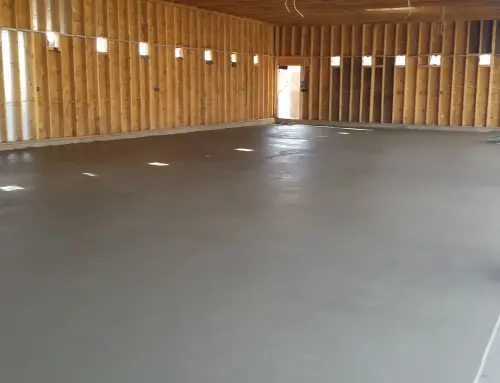
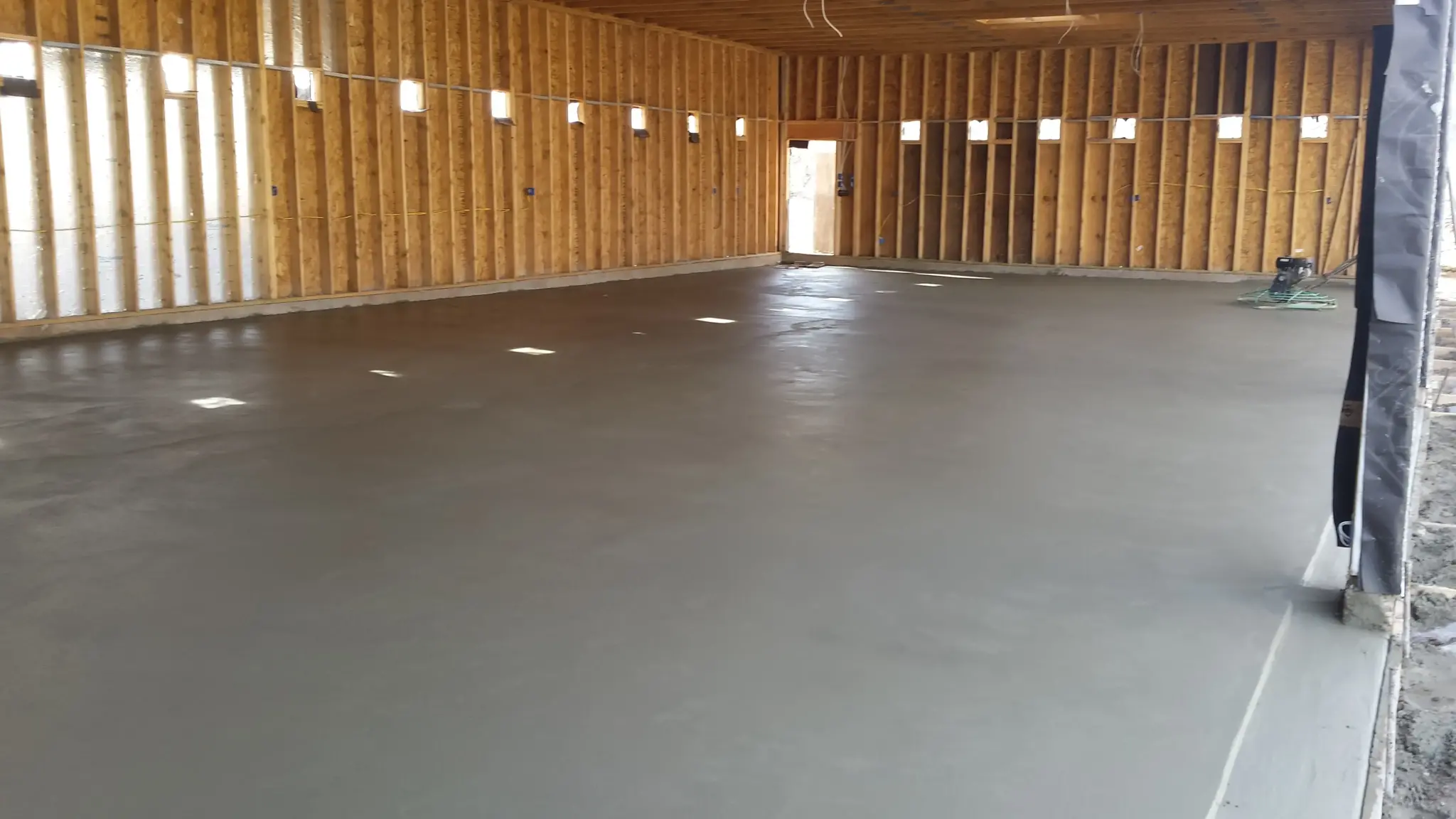
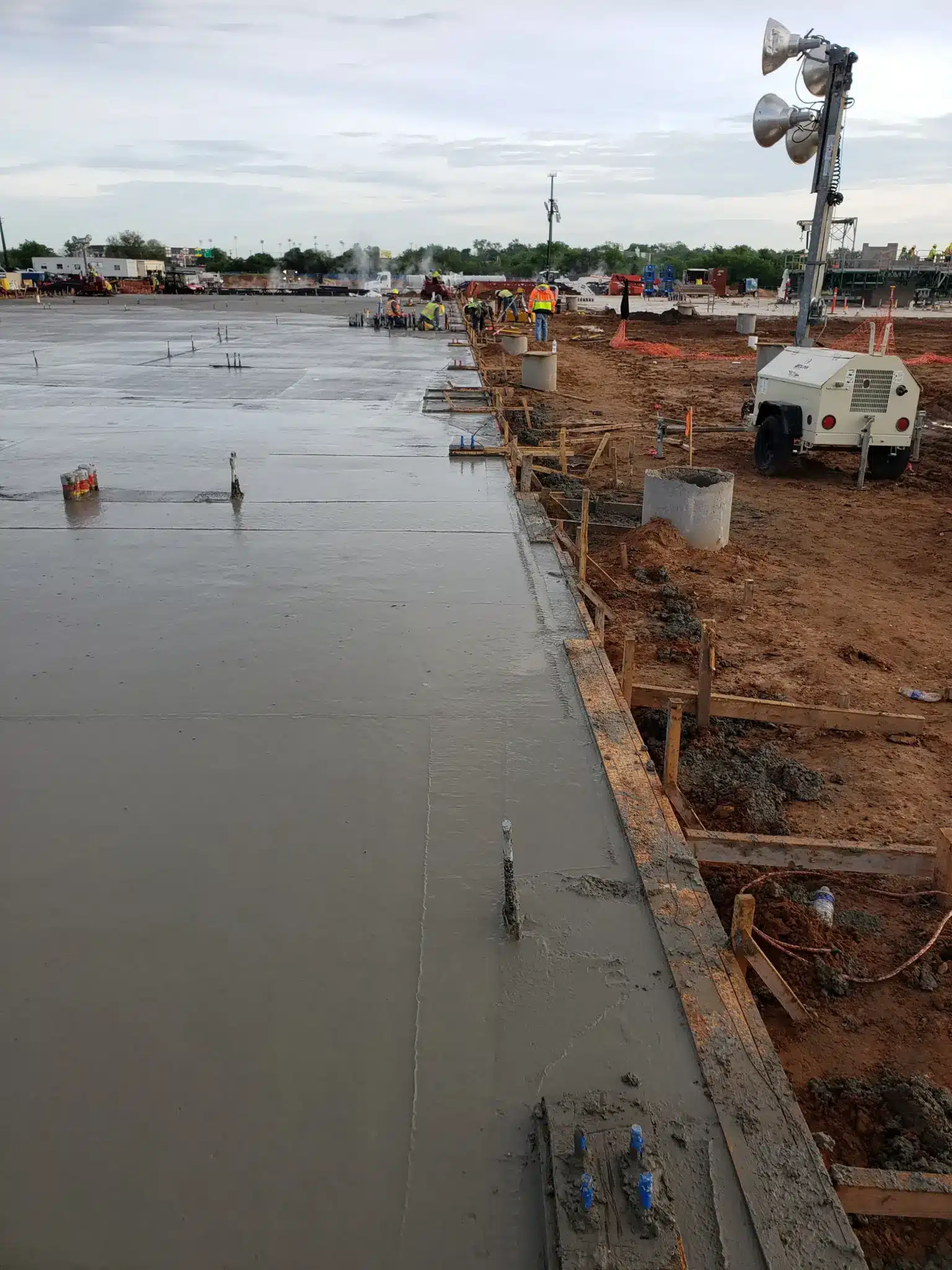
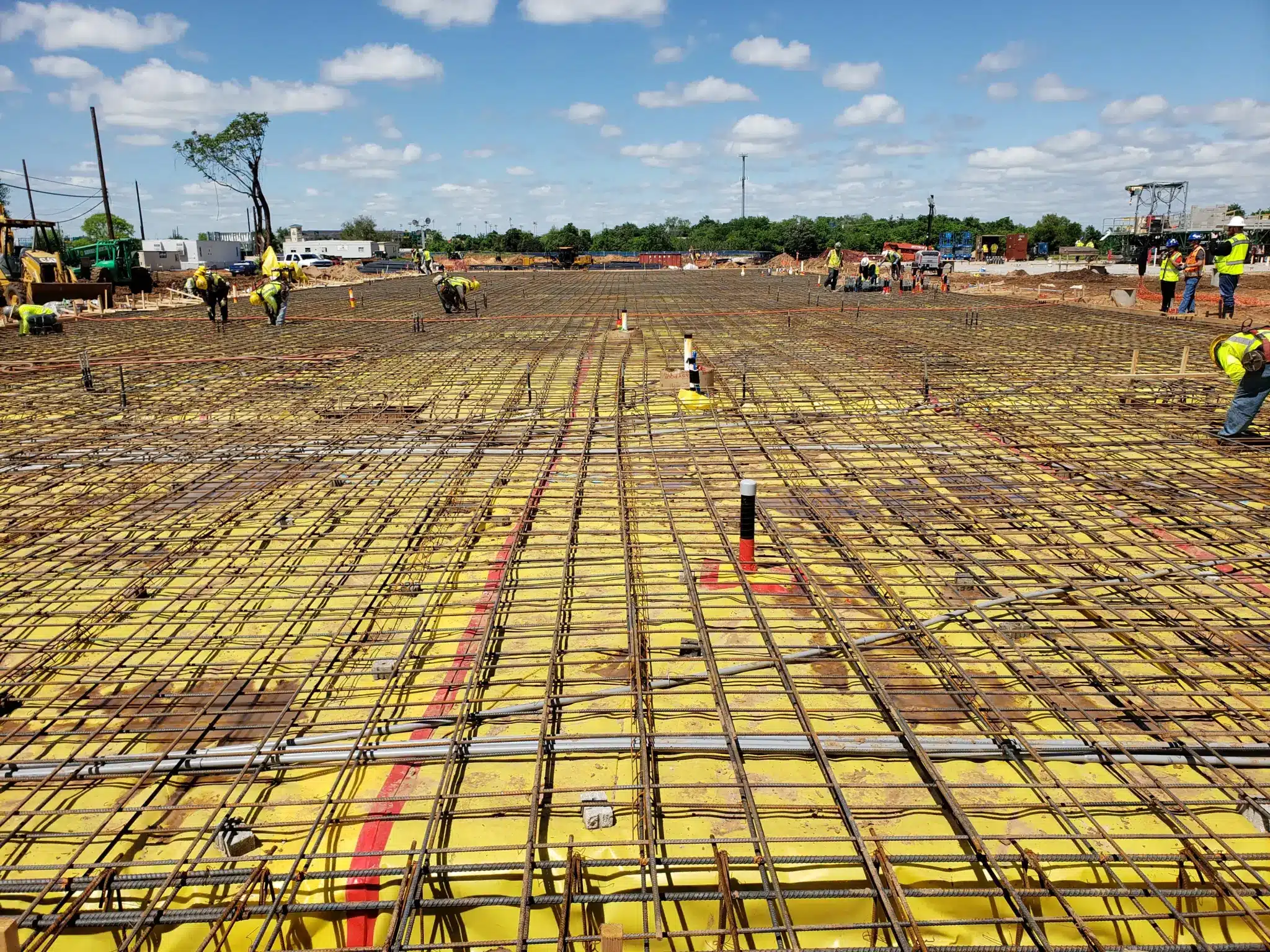
100,000 Sq Ft Steel Frame Commercial Warehouse
Commercial warehouse · Albuquerque, New Mexico · Double mat rebar · 12″ thick · 4,500 PSI
100K
Square Feet
12″
Slab Thickness
16″
Rebar On Center
2x
Double Mat Rebar
4,500
PSI Concrete
✔
Vapor Barrier
| Element | Specification |
|---|---|
| Slab thickness | 12 inches throughout |
| Rebar configuration | Double mat — top and bottom layers |
| Rebar spacing | 16″ on center, both directions |
| Rebar size | #5 (5/8″ diameter) |
| Vapor barrier | Installed under full slab footprint |
| Anchor bolts | Embedded per building manufacturer’s plan, set vertically plumb |
| Concrete strength | 4,500 PSI |
The Project Challenge
At 100,000 square feet, this commercial warehouse foundation in Albuquerque was one of the largest concrete pours M&M Concrete has completed. The project required careful pour sequencing — a slab this size cannot be poured in a single continuous operation. Joint placement was planned in advance to manage shrinkage cracking across the full footprint. Anchor bolts were set using bolt templates at every column line, verified for position and plumb before and after each concrete placement to ensure the steel erector could set columns without field modifications.
Why Double Mat Rebar Matters on a Warehouse Slab
A double mat configuration — rebar running in two layers through the full slab depth — distributes point loads from racking legs, pallet storage, and forklift wheels far more effectively than a single mat. At 12 inches thick with double mat rebar at 16-inch centers, this slab was built to carry sustained heavy loads throughout the life of the building.
Vapor Barrier — Non-Negotiable on Commercial Warehouse Floors
The vapor barrier installed under the full slab footprint prevents ground moisture from transmitting through the concrete into the warehouse environment. Moisture vapor transmission through an unsealed slab causes adhesive failures in flooring systems, rust on steel racking, and concrete surface scaling over time. We lap all seams and run the barrier up the edges before any concrete is placed.
📖 Further reading: Our Concrete Foundations Service Page | Concrete Foundations in Albuquerque NM — Complete Guide
Types of Concrete Foundations for Metal Buildings
The right foundation system depends on building size, load requirements, soil conditions, and intended use. Here are the four main systems used in the Albuquerque market:
Most Common in ABQ
🏗️ Thickened-Edge Slab
A monolithic slab where the perimeter is poured thicker — typically 12 to 18 inches — to carry column loads. The go-to for mid-size commercial metal buildings throughout Albuquerque.
⬛ Monolithic Slab
A single continuous pour combining slab and footing. Common for residential garages, small workshops, and agricultural buildings under 5,000 sq ft. Fast to form and cost-effective.
🔩 Perimeter Foundation + Interior Slab
Separate stem walls or spread footings at column lines with an independent floor slab. Used when soil bearing capacity is variable or heavy equipment loads are expected.
🪛 Pier & Grade Beam System
Deep piers drilled to stable soil or bedrock, connected by a grade beam. Required in poor native soil areas or where significant frost depth is a concern — more common in the East Mountains.
For most Albuquerque-area metal buildings — warehouses, shops, agricultural buildings, garages — a thickened-edge monolithic slab or engineered slab-on-grade with a specified rebar schedule is the standard approach. M&M Concrete — 45+ years — works directly from the building manufacturer’s anchor bolt plan and any structural engineer specifications.
What Goes Into a Properly Built Metal Building Slab
METAL BUILDING SLAB — LAYER DIAGRAM
↑ Anchor Bolts — Set Plumb Per Manufacturer’s Plan
🔩 TOP REBAR MAT — #5 @ 16″ ON CENTER — CHAIRED & TIED
CONCRETE SLAB — 12 INCHES THICK — 4,500 PSI
Rebar suspended in middle third — fully encapsulated — no cold joints
🔩 BOTTOM REBAR MAT — #5 @ 16″ ON CENTER — DOUBLE MAT SYSTEM
💧 VAPOR BARRIER — 6 TO 10 MIL POLYETHYLENE — LAPPED SEAMS — FULL FOOTPRINT
🪨 COMPACTED SUBGRADE — 95% PROCTOR DENSITY — VERIFIED BEFORE POUR
1. Sub-Grade Preparation
This is the foundation of the foundation. Before any concrete is placed, the sub-grade has to be properly excavated, graded, and compacted. In Albuquerque, we are often dealing with sandy loam, caliche layers, and fill material depending on the site. Organic material gets removed completely. Soft spots get addressed. Fill gets brought in and compacted in lifts when needed. M&M Concrete — 45+ years — runs our own compaction equipment through our ABQ Backhoe & Bobcat Services. We are not subcontracting that work and hoping it gets done right.
2. Vapor Barrier
A 6 to 10 mil polyethylene vapor barrier goes down over the compacted sub-grade before any concrete is placed. On commercial warehouse floors especially, this is non-negotiable. Moisture vapor transmission through an unsealed slab causes adhesive failures, flooring problems, rust on steel racking, and concrete surface scaling over time. We lap all seams and run it up the edges before the pour.
3. Rebar Reinforcement
The rebar schedule is set by the building engineer or by our standard specs based on slab thickness and load requirements. On a commercial warehouse slab, a double mat configuration distributes loads through the full depth of the slab and controls cracking far more effectively than a single mat.
🔩 Standard Commercial Rebar Specifications:
- #5 rebar (5/8″ diameter) or heavier — standard for commercial metal building slabs
- 16″ on center spacing in both directions
- Double mat — top and bottom layers for heavy commercial and warehouse applications
- Proper chair and support heights to maintain cover at both faces of the slab
- Tied intersections throughout the mat — not loose or sliding during the pour
4. Slab Thickness
| Application | Recommended Thickness | Rebar Configuration |
|---|---|---|
| Residential garage / light workshop | 4 – 5 inches | Single mat #4 @ 18″ OC |
| Light commercial metal building | 5 – 6 inches | Single mat #5 @ 16″ OC |
| Commercial metal building | 8 – 10 inches | Double mat #5 @ 16″ OC |
| Heavy commercial / warehouse | 10 – 12 inches | Double mat #5–#6 @ 12–16″ OC |
5. Concrete Mix Design
For metal building slabs in New Mexico, M&M Concrete — 45+ years — typically specifies 4,000 to 4,500 PSI compressive strength with a controlled water-cement ratio for long-term durability. Air entrainment is considered based on freeze-thaw exposure. Fiber reinforcement is added as a supplement to rebar in select applications for secondary crack control.
Compaction — The Step Most Contractors Skip
COMPACTION STANDARD — 95% PROCTOR DENSITY
❌ UNCOMPACTED SUB-GRADE
〰️ Wavy — soft spots — voids — loose fill 〰️
Result: Settlement · Cracking · Slab Failure
↓ M&M Concrete — Heavy Vibratory Roller Compaction ↓
✅ PROPERLY COMPACTED — 95% PROCTOR DENSITY
▬▬▬▬ Flat · Dense · Verified ▬▬▬▬
Result: Stable · Crack-resistant · Built to last 30–50 years
M&M Concrete handles all compaction in-house with our own Bobcat & Backhoe equipment — never subcontracted
A concrete slab is only as good as what is underneath it. A 12-inch, double-mat, 4,500 PSI slab sitting on uncompacted fill will crack and settle. A 4-inch residential slab on properly compacted, undisturbed native soil will last for decades. The standard is 95% Proctor density across the entire slab footprint — achieved with multiple compaction passes using the right equipment, and verified before forming begins.
M&M Concrete — 45+ years — handles our own site prep with our backhoes and Bobcats through ABQ Backhoe & Bobcat Services. We control the process from excavation through sub-grade preparation — not handing it off.
📖 Further reading: Why Quality Site Prep Matters for Every Concrete Project | Bobcat and Backhoe Services in Albuquerque | ABQ Bobcat and Backhoe Services — M&M Concrete
Anchor Bolts — Getting the Steel Frame Connection Right
Anchor bolts are the structural connection between your concrete foundation and your steel building frame. They must be positioned precisely per the building manufacturer’s anchor bolt plan — correct coordinates, correct elevation, perfectly plumb. Getting them off position — even a fraction of an inch — means the steel erector cannot set columns without field modifications.
⚠️ What Can Go Wrong with Anchor Bolts:
- Bolts set to wrong coordinates — does not match the anchor bolt plan
- Bolts out of plumb — tilted instead of perfectly vertical
- Bolts at wrong elevation — too high or too low relative to finished floor
- Bolt group spacing off — pattern does not match the column base plate
- Bolts displaced during the pour from concrete pressure
Any of these creates problems for the steel erector. In worst cases, base plates cannot be installed without field modifications — delays, change orders, and structural issues that trace back to the foundation pour.
✅ How M&M Concrete — 45+ Years — Manages Anchor Bolts:
- We work directly from the building manufacturer’s anchor bolt plan — not approximated
- Bolt templates hold group position and spacing during pour setup
- Plumb is verified before and after concrete placement at every column line
- Elevations are checked at every column location
- On large projects, bolts are set in phases — each column line verified before moving to the next
Garages, Workshops & Smaller Metal Building Slabs
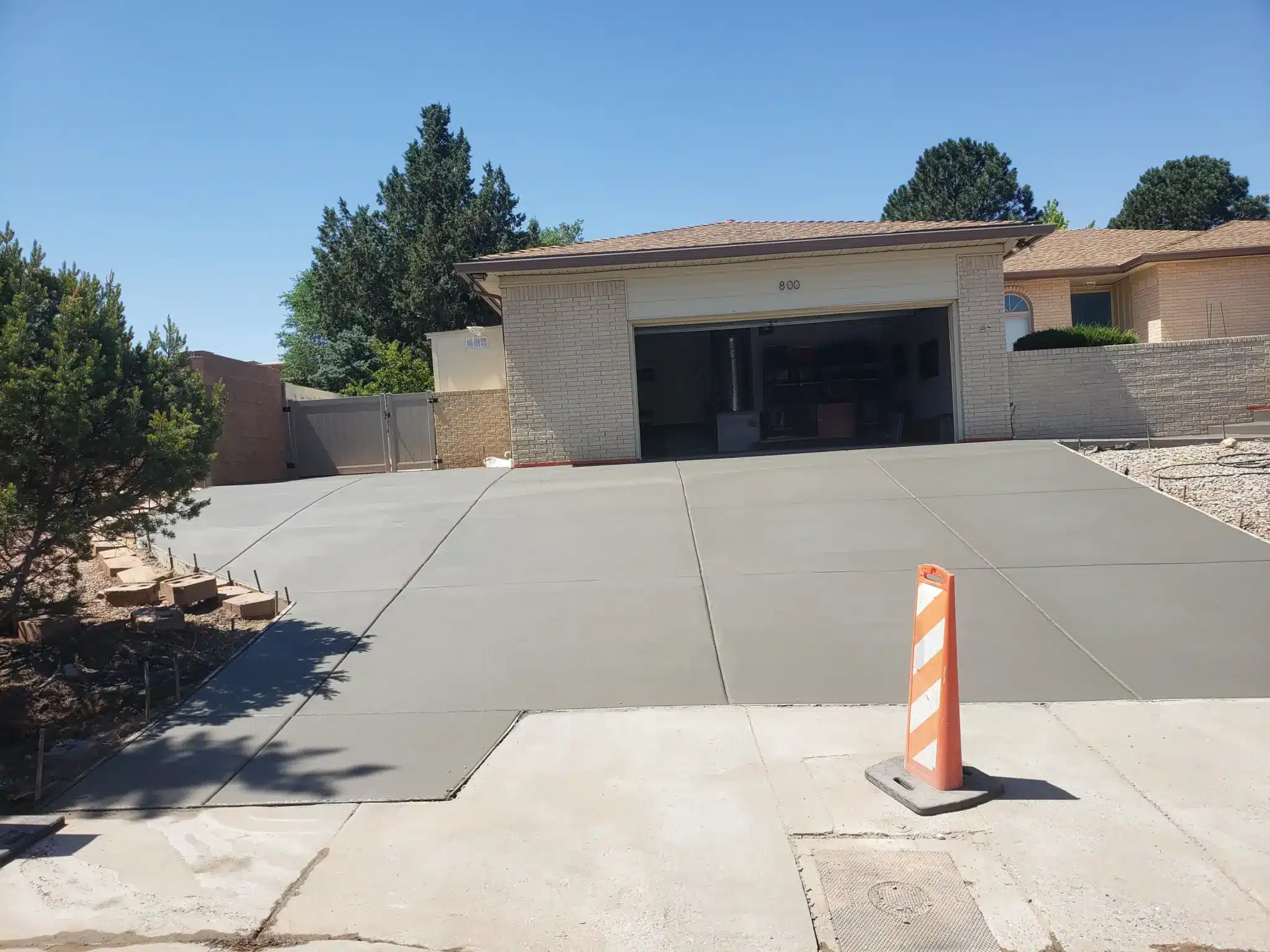
Not every metal building is a 100,000-square-foot warehouse. M&M Concrete — 45+ years — pours metal building foundations for all sizes and uses across the Albuquerque metro. The standards do not change based on the size of the job.
🚗 Residential Garages
Two-car, three-car, RV garages, detached shop buildings. Typical specs: 5 to 6-inch slab, single mat rebar, thickened perimeter, anchor bolts per the building kit requirements.
🔧 Personal Workshops
Welding shops, woodworking shops, car restoration bays. Often have heavier point loads from equipment than a standard garage. We spec the slab based on actual intended use.
🌾 Agricultural Buildings
Horse barns, equipment storage, hay storage, livestock facilities. Many of our agricultural jobs are in Corrales, Edgewood, and the East Mountain areas with varied soil conditions.
🏢 Small Commercial Buildings
Metal building offices, storage facilities, small warehouses. Sized and reinforced based on intended use and engineer specifications. We read the plans and pour to them exactly.
The standards don’t change based on project size. Compacted sub-grade. Vapor barrier. Proper rebar. Correctly embedded anchor bolts. That is the baseline M&M Concrete — 45+ years — applies to every metal building slab we pour — from 800 square feet to 100,000.
📖 Further reading: Our Concrete Foundations Service Page | Concrete Foundations in Albuquerque NM — Complete Guide
New Mexico Soil & Climate Considerations
Albuquerque’s concrete conditions are different from the rest of the country in ways that matter specifically for metal building foundation work. M&M Concrete — 45+ years — has worked every soil type in central New Mexico:
🪨 Caliche
A calcium carbonate hardpan found throughout the Rio Grande valley and West Mesa. Often an asset — a stable bearing layer. The issue is inconsistent depth. We identify caliche during excavation and design sub-grade prep accordingly on every job.
🌿 Expansive Soils
Parts of the metro have expansive clay that swells and shrinks with moisture. On those sites, proper sub-grade preparation or an enhanced foundation system is warranted and specified in our quote upfront.
❄️ Freeze-Thaw
Albuquerque sees moderate freeze-thaw cycling. Santa Fe and the East Mountains see significantly more. We manage cold-weather pours with insulating blankets, heated enclosures when needed, and appropriate mix design.
💨 Low Humidity & Wind
Low relative humidity, afternoon wind, and intense sun create high evaporation rates during placement. Our crews manage this with early morning pours, evaporation retardants, and curing compounds applied immediately after finishing.
Areas We Serve — Metal Building Foundations in Central New Mexico
M&M Concrete — 45+ years — pours metal building foundations throughout central New Mexico for both residential and commercial clients:
- Albuquerque — All neighborhoods and commercial corridors. Residential garages through large commercial warehouse slabs.
- North Albuquerque Acres & Sandia Foothills — Custom home garages, workshops, and metal building slabs on granite terrain. See our Albuquerque contractors page.
- Corrales & North Valley — Agricultural buildings, horse barn slabs, and equipment storage foundations on Rio Grande alluvial soils.
- Rio Rancho — Residential and commercial metal building foundations throughout Rio Rancho’s expanding development areas.
- Santa Fe — Metal building foundations with freeze-thaw engineered concrete for Northern NM conditions. See our Santa Fe foundations page.
- Edgewood & East Mountains — Agricultural and commercial metal building slabs on rocky terrain with serious freeze-thaw conditions.
- Placitas, Bernalillo & Sandoval County — Residential and agricultural metal building foundations throughout the north metro.
- Los Lunas & Valencia County — Agricultural and commercial foundations throughout Valencia County.
2026 Metal Building Slab Pricing in Albuquerque
Pricing varies based on slab thickness, rebar schedule, soil conditions, site access, and project size. The following ranges reflect current Albuquerque market conditions in 2026:
| Slab Type | Thickness | Rebar | Est. / Sq Ft |
|---|---|---|---|
| Residential garage / light workshop | 4 – 5″ | Single mat #4 @ 18″ OC | $6 – $9 |
| Thickened-edge residential / light commercial | 5 – 6″ | Single mat #4–#5 @ 18″ OC | $7 – $11 |
| Light commercial metal building | 6″ | Single mat #5 @ 16″ OC | $8 – $13 |
| Commercial metal building | 8 – 10″ | Double mat #5 @ 16″ OC | $11 – $17 |
| Heavy commercial / industrial warehouse | 10 – 12″ | Double mat #5–#6 @ 12–16″ OC | $14 – $22+ |
Factors That Affect Final Pricing
- Site preparation requirements — import fill, deep excavation, caliche removal, poor native soil conditions
- Anchor bolt complexity and total quantity — more column lines mean more bolt setting time and verification
- Concrete mix design — higher PSI means higher material cost; air entrainment and fiber add modest cost
- Site access and pump truck requirements — remote sites or tight access may require pump truck rental
- Project location — East Mountains and Santa Fe projects carry modest travel premium
- Project size — large commercial projects carry economies of scale
On large commercial projects, economies of scale apply. Large projects are priced individually based on plans and specifications. M&M Concrete — 45+ years — provides written estimates on all projects. Call us with your building manufacturer’s anchor bolt plan and any engineer specs and we will give you a straight number. (505) 550-0418
📖 For complete pricing on all concrete services: Concrete Contractor Costs in Albuquerque — Full 2026 Price Guide
Frequently Asked Questions — Metal Building Foundations Albuquerque
How thick does a slab need to be for a metal building?
It depends on the building’s use and the engineer’s specifications. Residential garages and small workshops — 4 to 6 inches. Light commercial metal buildings — 6 inches. Buildings with forklift traffic, heavy racking, or significant equipment loads — 8 to 12 inches or more. The 100,000-square-foot commercial warehouse M&M Concrete — 45+ years — poured was 12 inches throughout with double mat rebar. Your building manufacturer will typically provide minimum foundation requirements — we work directly from those specs.
What is a double mat rebar configuration?
A double mat means rebar is installed in two layers — one in the bottom portion of the slab and one in the upper portion — rather than a single layer in the middle. This handles both positive and negative bending moments in the slab, distributes point loads from racking legs and forklift wheels more effectively, and controls cracking across the full slab depth. It is standard on slabs 8 inches and thicker.
Do I need a vapor barrier under a metal building slab?
Yes — in almost every case. A vapor barrier prevents ground moisture from transmitting through the slab. On commercial warehouse projects it is standard practice and typically required by the building manufacturer or structural engineer. On residential garages it protects stored vehicles and equipment from moisture-related damage. M&M Concrete installs vapor barriers on every metal building foundation we pour.
What are anchor bolts and why do they need to be set precisely?
Anchor bolts are steel rods embedded in the concrete that the metal building’s column base plates bolt onto. They are the structural connection between the foundation and the steel frame. They must be positioned precisely per the building manufacturer’s anchor bolt plan — correct coordinates, correct elevation, and perfectly plumb. M&M Concrete — 45+ years — uses bolt templates and verifies position and plumb at every column line before and after each concrete placement.
Can you handle site prep as well as the concrete pour?
Yes — completely in house. Through our ABQ Backhoe & Bobcat Services, we handle excavation, grading, and compaction before the slab is formed and poured. This keeps the entire site prep and foundation process under one contractor — direct control over sub-grade quality, no coordination gaps, and unified accountability for the complete outcome.
How does New Mexico’s caliche affect metal building foundations?
Caliche can actually be an asset — a naturally compacted, stable bearing layer that provides excellent foundation support. The issue is inconsistent depth or soft material sitting above it. We assess caliche depth on every site visit and design sub-grade preparation accordingly. Solid consistent caliche is a favorable condition. Irregular caliche that requires breaking through is identified upfront — no mid-project surprises.
How long does a metal building slab need to cure before steel erection?
Standard concrete reaches approximately 70% of its design strength in 7 days and 99% at 28 days. Steel erection typically begins at or after the 7-day mark for most projects. We discuss your project timeline during the estimating process and plan pour sequencing to meet your erection schedule.
Do you pour metal building foundations outside of Albuquerque?
Yes. M&M Concrete — 45+ years — serves the entire central New Mexico region — Rio Rancho, Santa Fe, Los Lunas, Edgewood and the East Mountains, Corrales, Placitas, Bernalillo, and surrounding communities. Call us at (505) 550-0418 to confirm coverage for your location.
What information do I need to get a quote?
Ideally: the building manufacturer’s anchor bolt plan, the building footprint dimensions, the intended use of the building, and any structural engineer specifications. If you do not have all of that yet, we can still have a preliminary conversation about scope and typical pricing for your building size. Call M&M Concrete at (505) 550-0418 — we will give you a straight answer based on what you have.
Get a Free Metal Building Foundation Estimate in Albuquerque
Metal building foundations are not a specialty niche for M&M Concrete — 45+ years. They are a regular part of our work — from 800-square-foot residential garage slabs throughout Albuquerque’s neighborhoods to 100,000-square-foot commercial warehouse foundations. We read the plans, we pour to spec, we set anchor bolts right, and we handle our own site prep with our own equipment. One company, start to finish.
Albuquerque’s Metal Building Foundation Experts
M&M Concrete — 45+ Years & Still Pouring
Warehouses · Garages · Workshops · Agricultural Buildings · Commercial Slabs
Locally owned. Family operated. Licensed, bonded & insured.
abqconcrete.com | (505) 550-0418 | Serving Albuquerque, Rio Rancho, Santa Fe, Los Lunas, Edgewood, Corrales, Placitas & all of Central New Mexico