abqconcrete.com | (505) 550-0418
Free Estimates — Albuquerque & Central New Mexico
M&M CONCRETE — RESIDENTIAL CONCRETE CONTRACTORS IN ALBUQUERQUE
45+ Years Licensed & Operating in New Mexico | (505) 550-0418 | abqconcrete.com
🏡 Foundations · Driveways · Patios · Stamped Concrete · Garages · Retaining Walls · Free Estimates — Albuquerque & Central New Mexico
Table of Contents
- What Residential Concrete Contractors in Albuquerque Actually Do
- Case Study — Full-Scale Residential Project in the South Valley
- Residential Concrete Services We Provide
- What Goes Into a Properly Built Residential Project
- Compaction — The Step Most Contractors Skip
- Residential Concrete Mistakes We See — And How We Avoid Them
- One Crew — Start to Finish
- South Valley & Albuquerque Soil — What Every Homeowner Needs to Know
- Areas We Serve
- 2026 Residential Concrete Pricing in Albuquerque
- Frequently Asked Questions
- Get a Free Estimate
What Residential Concrete Contractors in Albuquerque Actually Do
When Albuquerque homeowners search for residential concrete contractors, they are not looking for someone who pours concrete as a side job. They are looking for a contractor who has done this specific type of work — foundations for custom homes, driveways that last, patios that look great and drain correctly, garages built for real loads — in this specific city, on this specific soil. That is a short list.A quick search turns up dozens of names, but most of them are general contractors who occasionally pour concrete, or crews that primarily do commercial work and take on residential jobs when things are slow. Neither of those is what a homeowner actually needs. Residential concrete requires a contractor who lives in the details a general contractor skips and treats a driveway with the same structural seriousness as a commercial slab, because the person paying for it is going to look at that driveway every single day for the next thirty years.
That daily visibility is exactly what raises the bar for residential work. A commercial parking lot gets driven over by strangers who never notice a slightly uneven joint. A homeowner notices immediately, every time they walk out their front door — which is precisely why the finishing standard on residential concrete has to be higher, not lower, than commercial work.
Why Residential Work Demands a Different Standard
M&M Concrete has been the residential concrete contractor Albuquerque homeowners call since the 1970s. Over 45 years, we have poured foundations for custom homes throughout the metro, replaced thousands of driveways, built hundreds of patios, and handled every residential concrete challenge New Mexico can produce. If you’ve compared quotes from other concrete contractors in Albuquerque or checked out our concrete contractor in Albuquerque NM guide, you already know local experience isn’t optional here. Residential concrete is different from commercial concrete in ways that matter — the projects are personal, the communication requirements are different, and the finishing standards are higher, because residential concrete is looked at every day by the people who live there.
Six Things a Good Contractor Does Beyond the Pour
✅ What a Good Residential Concrete Contractor Does — Not Just the Pour:
- Assesses your specific soil conditions before quoting — caliche in the Heights, clay in the South Valley, granite in the Foothills, sandy loam on the West Mesa
- Handles demolition and site prep in house — a contractor who subcontracts excavation does not fully control the quality of the most critical phase of your project
- Specifies the right concrete mix — a residential driveway in Albuquerque needs 4,000 PSI with air entrainment, not a standard 3,000 PSI mix
- Places reinforcement correctly — properly chaired rebar suspended in the middle of the slab, never rebar sitting on the ground
- Designs drainage properly — concrete that drains toward your house is concrete that attacks your foundation every time it rains
- Manages the cure — curing compounds and management of the critical first 72 hours to ensure the concrete reaches its design strength
Most homeowners never know the difference between a contractor who does all six of these and one who only does the pour — until the slab starts spalling in five years. Call us at (505) 550-0418 for a free estimate.
📖 Further reading: Concrete Contractors Albuquerque | Concrete Installations Albuquerque — The Engineering Standard
Case Study — Full-Scale Residential Project in the South Valley
REAL PROJECT · SOUTH VALLEY, ALBUQUERQUE · M&M CONCRETE
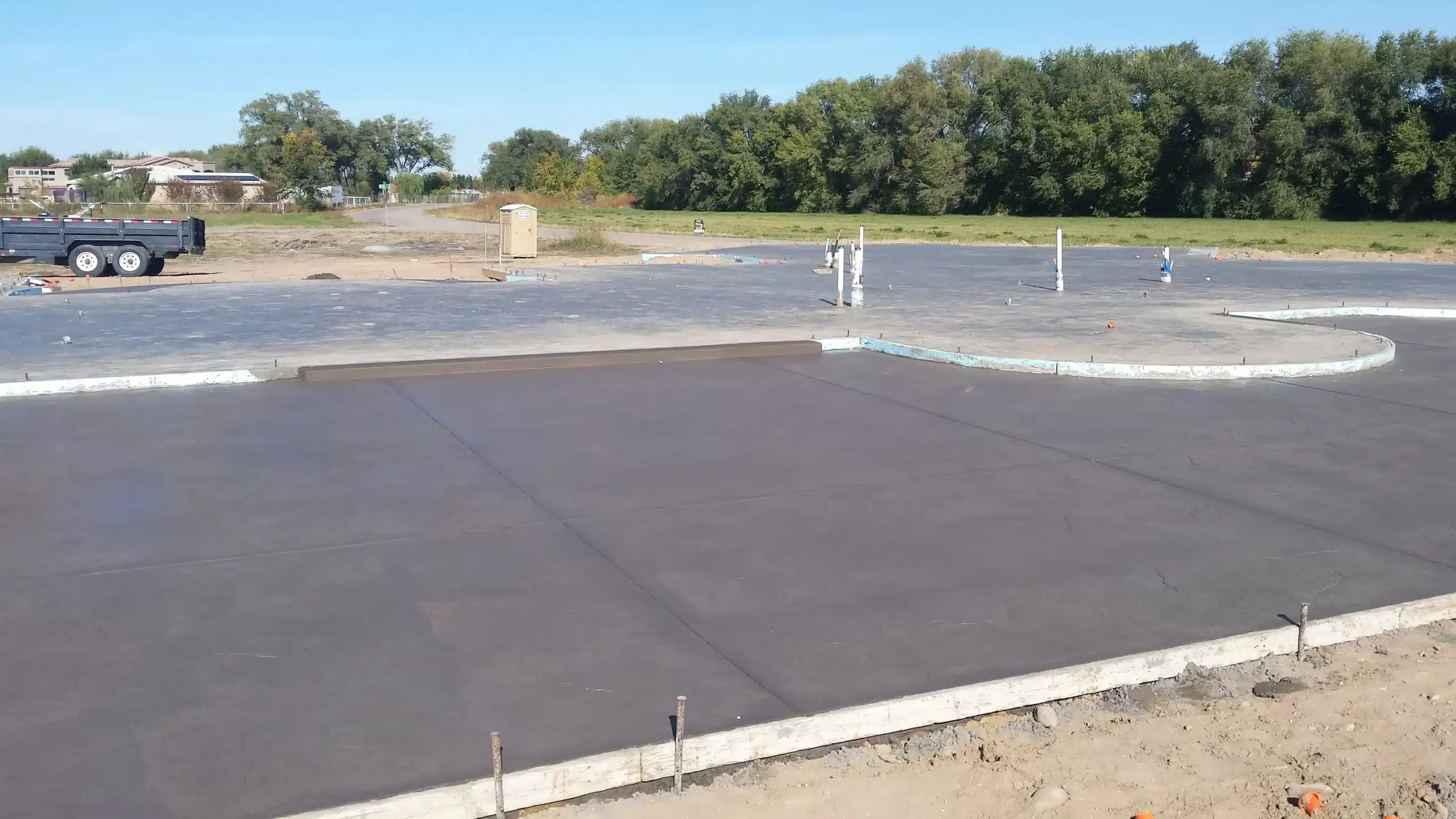
8,000 Sq Ft Heated Foundation + 3,000 Sq Ft Designer Patios + 2,800 Sq Ft Garage Slabs
Residential · South Valley, Albuquerque, New Mexico · Full-scope custom home project
8,000
Sq Ft Heated Foundation
3,000
Sq Ft Designer Patios
2,800
Sq Ft Garage Slabs
🔥
Radiant Floor Heating
🎨
Stamped Flagstone
95%
Proctor Density
| Element | Specification |
|---|---|
| Heated foundation slab | 8,000 square feet, radiant in-floor heating embedded |
| Designer patios | 3,000 square feet, stamped flagstone with colored concrete |
| Garage slabs | 2,800 square feet, poured to commercial specifications |
| Sub-grade | Rio Grande alluvial clay, silt, and sand |
| Additional scope | Custom driveways, addition foundations, structural retaining walls |
| Location | South Valley, Albuquerque, New Mexico |
The South Valley Challenge
One of the most comprehensive residential concrete projects we have completed in recent years was a full-scope custom home project in Albuquerque’s South Valley — one of the most demanding environments for concrete work in the metro due to its Rio Grande alluvial soils, high clay content, and drainage requirements. The soil is a mix of clay, silt, and sand deposited by the river over centuries. Clay-bearing soils expand when wet and contract when dry, creating constant movement under concrete slabs that isn’t properly accounted for with standard techniques. Additionally, organic material from decades of agricultural and landscaping use in this established neighborhood is common in the sub-grade — and organic material left under concrete decays and creates voids that cause settling and cracking.
The South Valley has a longer settlement history than many parts of Albuquerque, which means properties here often carry decades of accumulated landscaping, irrigation ditches, and small-scale agricultural use that a newer subdivision simply doesn’t have. That history shows up underground in ways a contractor unfamiliar with the area won’t anticipate — old irrigation lines, buried organic material from removed orchards, and inconsistent fill from generations of small improvements. Reading a South Valley lot correctly means accounting for all of that before committing to an excavation plan.
Designing Around the Clay
We knew all of this before we dug the first shovel of dirt. Forty-five years of working Albuquerque’s soil means South Valley clay is not a surprise to us — it’s something we design around. That kind of pre-existing knowledge changes the entire planning conversation with a homeowner: instead of discovering clay pockets mid-excavation and issuing a change order, we walk the site knowing roughly what to expect and confirm it with test digs before the first form board goes in.
The Heated Foundation — Zero Room for Error
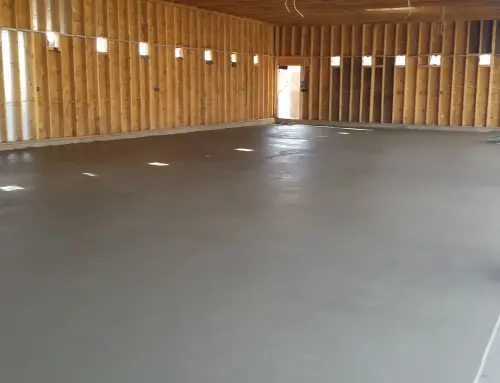
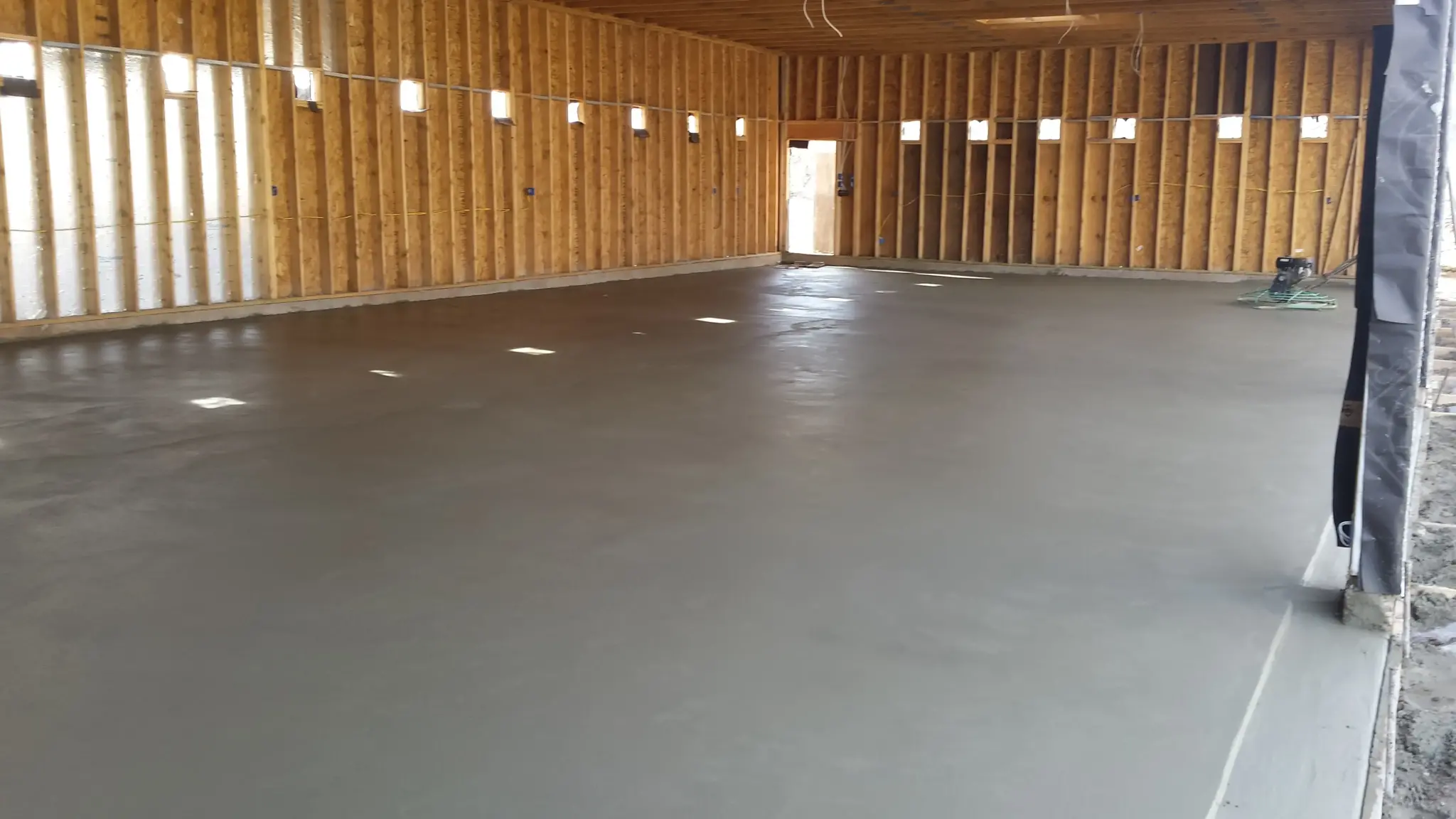
The 8,000 square foot heated foundation slab was the most technically demanding pour on this project. The radiant in-floor heating tubing had to be correctly positioned before the pour, the concrete placement had to protect the tubing during finishing, and the flatness tolerances had to meet the requirements of the finished floor system above. One mistake during this pour compromises the heating system and the finished flooring for the life of the home. We got it right.
Coordinating a heated slab pour means working hand in hand with the mechanical contractor who installs the radiant tubing before we ever schedule the truck. The tubing has to be pressure-tested and confirmed leak-free before concrete goes over it, because once that slab is poured, accessing a damaged tubing run means breaking out concrete — an expensive and disruptive repair on a finished home. Our placement crew worked in coordinated sections to avoid dragging equipment or foot traffic across freshly laid tubing, and we monitored pressure gauges throughout the pour to catch any damage immediately rather than discovering it after the concrete had cured.
Patios, Garages & the Rest of the Property
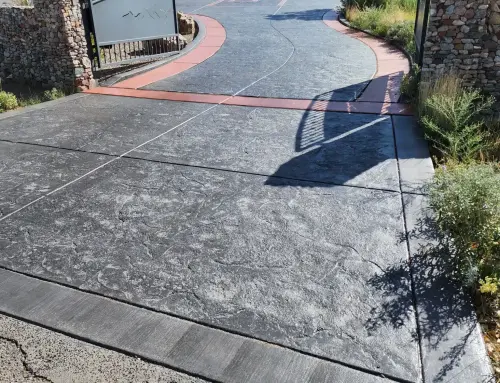
The 3,000 square foot designer patios were finished in a stamped flagstone pattern with colored concrete, designed to complement the South Valley’s natural landscape. At that scale, drainage design was critical — 3,000 square feet of impervious surface generates significant runoff during monsoon season, and every square foot drains correctly. The 2,800 square feet of garage slabs were poured to commercial specifications — higher PSI, heavier rebar schedule — because these garages handle trucks, RVs, and equipment, not standard residential loads. Custom driveways, addition foundations, and structural retaining walls rounded out the project, all tied together by the same grading and drainage plan.
Managing a project with this many distinct scopes on one property means sequencing matters as much as execution. We poured the garage slabs and driveway sections before the patios in areas where equipment access needed to cross what would eventually become finished, sealed decorative surfaces — avoiding the common mistake of finishing a beautiful stamped patio and then driving heavy equipment across it for a later phase.
Keeping One Property, One Elevation Plan
Grading elevations were locked in across the entire property before any individual pour began, so patios, driveways, and garage slabs all tie together at consistent elevations rather than each section being graded independently and creating awkward transitions where they meet.
Every phase — from the first excavation cut to the final sealer application — handled by one crew. Complete grubbing, clay pocket treatment, precision grading, and compaction to 95% Proctor density across every pour area. M&M Concrete — 45+ years — call (505) 550-0418.
📖 Further reading: Consumer Guide — How to Spot Fake Contractors | Concrete Driveways and Patios Guide
Residential Concrete Services We Provide
We handle the full range of residential concrete work throughout Albuquerque and central New Mexico. Additionally, whether your project is a single driveway or a complete custom home package like the South Valley case study above, the same crew and the same standards apply.
Every Service at a Glance
- Foundations — Custom homes, home additions, garages, workshops, and metal buildings, poured as monolithic slabs, stem wall systems, or heated slabs depending on the structure and soil.
- Driveways — Standard gray, colored, stamped, or exposed aggregate, poured to 4,000 PSI with proper base, rebar, and sealing for a 30 to 50 year service life.
- Patios — Broom, colored, stamped, exposed aggregate, or salt finish, drained and reinforced for daily outdoor living.
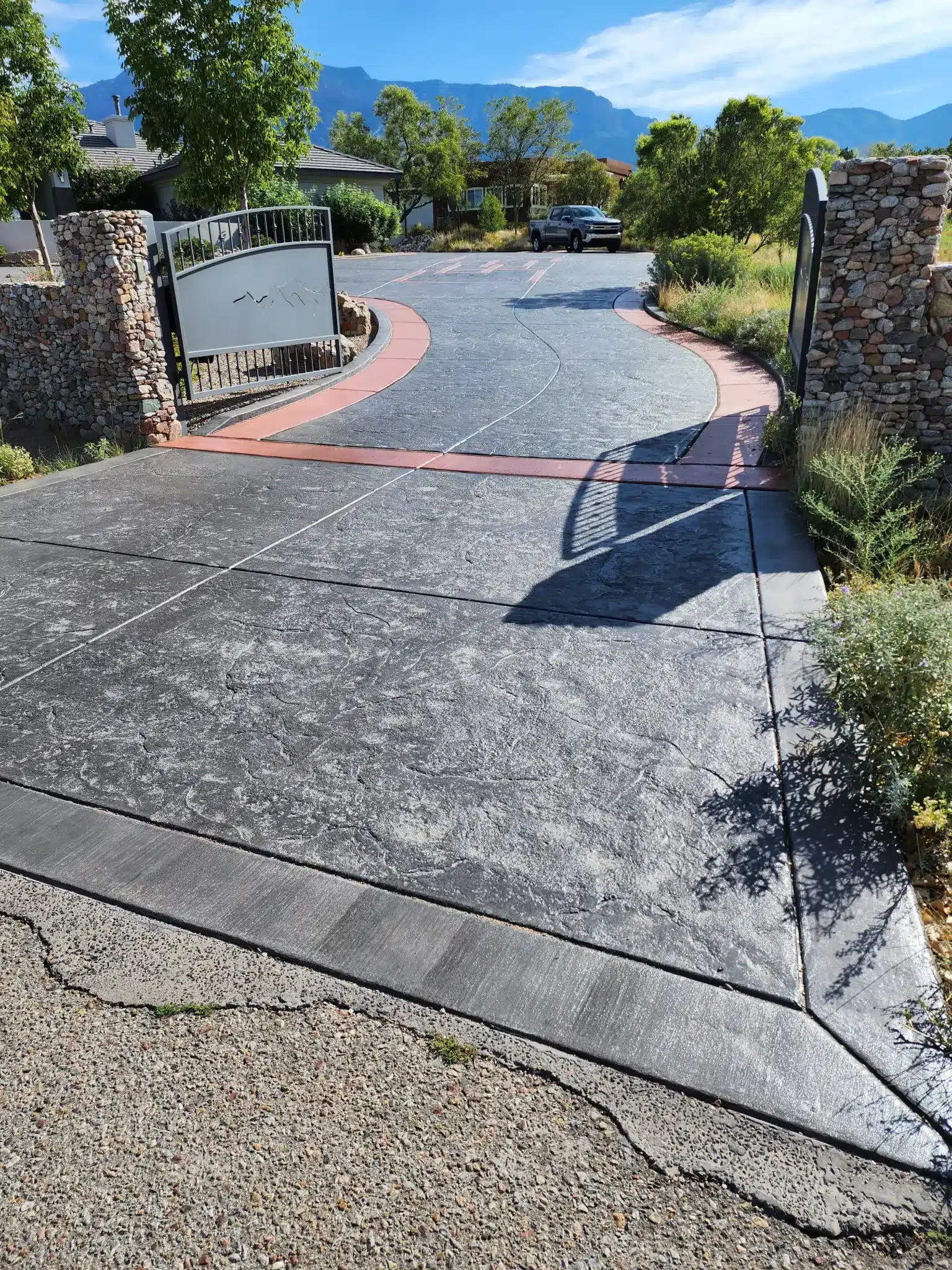
- Stamped & decorative concrete — Flagstone, Ashlar slate, cobblestone, wood plank, and brick patterns for patios and driveways.
- Demolition & replacement — Full tear-out and haul-off of failed concrete, followed by a correctly prepared sub-grade and new pour.
- Retaining walls — Gravity, cantilever, and tiered systems engineered for Albuquerque soil pressure and monsoon drainage.
- Sidewalks & walkways — Front walkways and connecting paths built to the same structural standard as our driveways.
- Parking areas & pads — RV pads and extra parking or equipment hardstand built for real vehicle weight.
- Excavation & site prep — Grading, compaction, dirt removal, junk and debris removal, and land clearing, all handled in-house.
Core Residential Services
Most Requested
🏗️ Custom Home Foundations
Foundations for custom homes, home additions, garages, workshops, and metal buildings — monolithic slabs, stem wall systems, heated slabs, addition foundations — all engineered for Albuquerque’s specific soil conditions and structural loads. See our foundations service page, our concrete foundations in Albuquerque guide, and our metal building slabs guide.
🚗 Concrete Driveways
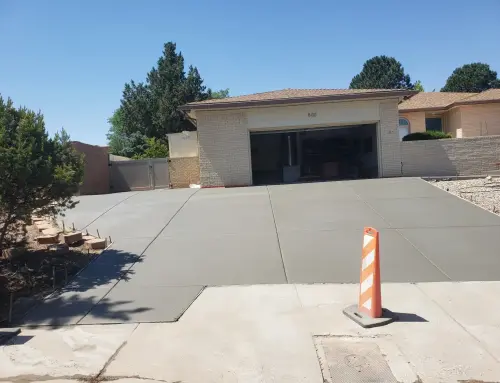
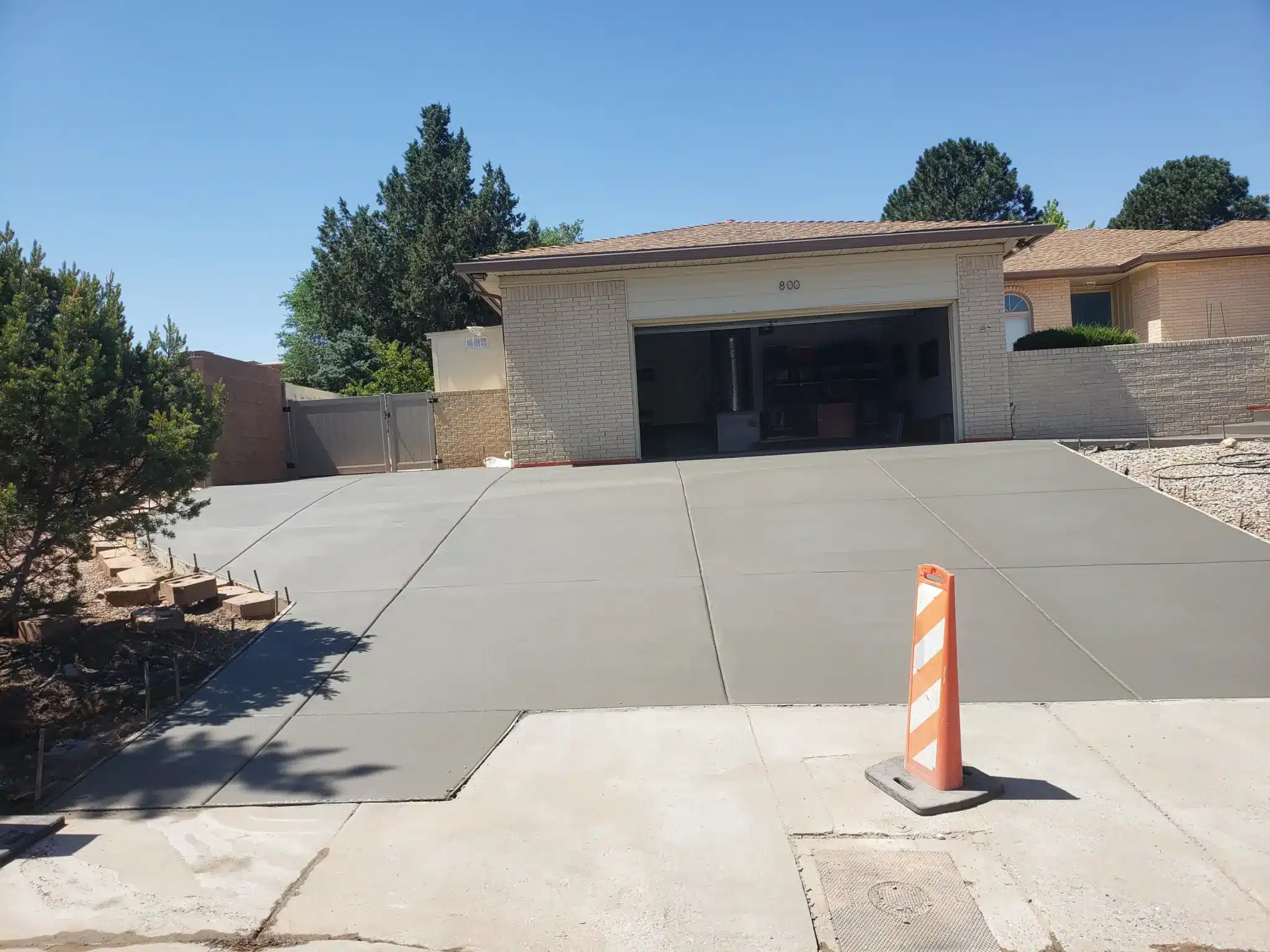
Standard gray, colored, stamped, or exposed aggregate — poured to 4,000 PSI with proper base prep, rebar, control joints, and sealing. A properly installed driveway lasts 30 to 50 years. See our concrete driveways page, our driveway contractors guide, and our driveway installation guide.
🏡 Concrete Patios
Broom finish, colored, stamped, exposed aggregate, salt finish — every finish, every size, every access condition. Albuquerque gets 310+ days of sunshine a year. See our concrete patios in Albuquerque & Rio Rancho guide.
Additional Residential Services
🎨 Stamped & Decorative Concrete
Flagstone, Ashlar slate, cobblestone, wood plank, brick — in colors that complement New Mexico’s Southwest architecture. See our stamped concrete page, our stamped patios and driveways guide, and our stamped concrete contractors guide.
🔨 Demolition & Replacement
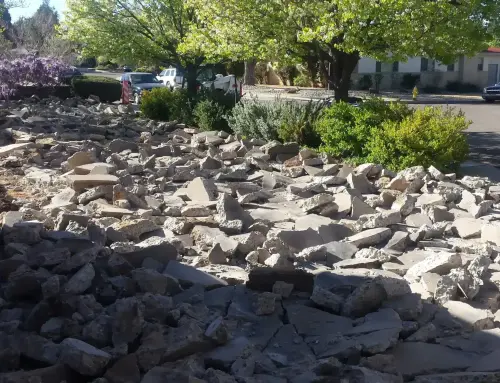
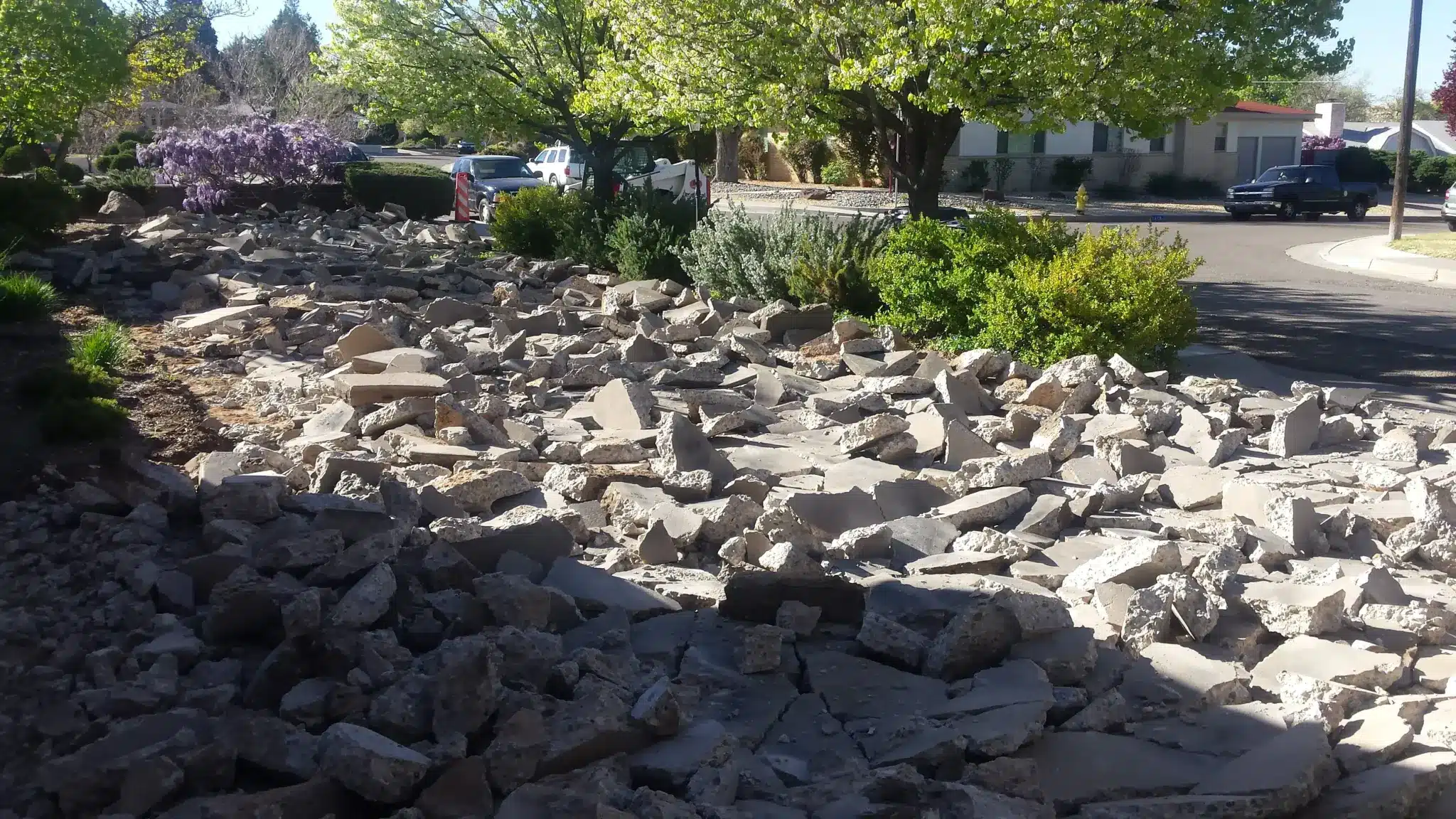
Old cracked concrete removed and replaced correctly this time. We handle demolition, haul-off, and the complete replacement scope in house. See our demolition page and demolition and replacement guide.
🧱 Retaining Walls
Poured concrete retaining walls engineered for Albuquerque’s soil conditions and monsoon drainage loads — gravity walls, cantilever walls, and tiered systems for properties with grade changes. See our retaining walls guide.
Sidewalks, Parking Areas & Property Site Prep
🚶 Sidewalks & Walkways
Front walkways, side yard access paths, and connecting sidewalks poured to the same structural standard as our driveways. See our concrete sidewalks guide.
🅿️ Parking Areas & Pads
RV pads, extra parking areas, and hardstand for equipment or trailers — built to handle real vehicle weight. See our concrete parking lots guide.
Every residential project also depends on the site prep underneath it. We handle junk and debris removal, dirt grading and removal, and excavating as standalone services or as part of a concrete project — see our dirt work guide for the full scope.
What Goes Into a Properly Built Residential Project
Here’s what actually happens on every residential job we take on. No shortcuts, no skipped steps.
The Anatomy of a Properly Built Residential Slab
RESIDENTIAL SLAB — LAYER DIAGRAM
🔩 REBAR — CHAIRED & SUSPENDED IN THE MIDDLE THIRD
CONCRETE SLAB — 4,000+ PSI, AIR-ENTRAINED
Rebar fully encapsulated — no cold joints
💧 VAPOR BARRIER — LAPPED SEAMS — FULL FOOTPRINT (FOUNDATIONS)
🪨 COMPACTED SUBGRADE — 95% PROCTOR DENSITY — VERIFIED BEFORE POUR
1. Soil Assessment
We identify what’s under your property — caliche, clay pockets, granite, sandy loam — before we quote. The right contractor designs the project around the soil, not the other way around.
2. Site Prep & Excavation
Using our own backhoes and Bobcats, we excavate, grub, and clear organic material completely. We don’t subcontract this — our crew controls it from start to finish.
3. Sub-Grade Compaction
We compact the base in layers and verify bearing capacity before we form anything. This is the step most rushed by other contractors — and the one that determines whether your slab lasts 5 years or 50.
4. Reinforcement
Properly chaired rebar, sized and spaced for the application — never wire mesh sitting on the ground. Rebar suspended in the middle third of the slab is what gives concrete its tensile strength when the soil beneath it moves.
5. The Pour & Finish
We schedule pours to avoid extreme heat and cold, manage placement to avoid cold joints and honeycombing, and finish to the specified texture — broom, stamped, exposed aggregate, or trowel. Timing matters most on decorative finishes, where the concrete has to be at exactly the right plasticity for stamping or exposing aggregate — too early and the pattern won’t set, too late and the surface tears.
6. Curing
We apply curing compound and manage the critical first 72 hours. In Albuquerque’s dry air, this step is what separates concrete that reaches full design strength from concrete that doesn’t. Concrete that loses moisture too fast during curing never reaches its rated PSI, no matter how good the mix design was on paper.
📖 Further reading: Driveway Replacement Albuquerque | Bobcat and Backhoe Services in Albuquerque
Compaction — The Step Most Contractors Skip
COMPACTION STANDARD — 95% PROCTOR DENSITY
❌ UNCOMPACTED SUB-GRADE
〰️ Loose · Voids · Soft spots · No bearing capacity 〰️
Result: Settlement · Cracking · Failure within a few years
↓ M&M Concrete — In-House Vibratory Compaction — ABQ Backhoe & Bobcat ↓
✅ COMPACTED TO 95% PROCTOR DENSITY
▬▬▬▬ Dense · Uniform · Verified Before Forming ▬▬▬▬
Result: Stable bearing layer · 30–50 year service life
All compaction handled in-house — M&M Concrete / ABQ Backhoe & Bobcat Services — never subcontracted
Concrete weighs roughly 4,000 pounds per cubic yard. If the dirt underneath isn’t professionally compacted, the weight of the concrete settles the earth for you — over months and years, not all at once, which is exactly why it catches homeowners off guard. Consequently, this is the number one cause of sunken driveways, cracked patios, and settled garage slabs throughout Albuquerque.
We compact every residential site to 95% Proctor density, verified with testing equipment, not eyeballed. That standard applies whether we’re pouring a 400 square foot patio or an 8,000 square foot heated foundation — the compaction process doesn’t get shortcut just because a project is small, and it doesn’t get skipped because a homeowner is in a hurry to see concrete on the ground. The few extra hours that proper compaction adds to a project timeline are the cheapest insurance a homeowner can buy against a cracked slab five years down the road.
Why This Matters More on a Multi-Structure Property
On a project involving a home, a garage, and patios on one lot — like the South Valley case study above — uneven compaction between the different pours creates differential settling between structures. If the garage sub-grade settles at a different rate than the home’s foundation, the two structures move independently of each other over time, even a few feet apart. Compacting every scope on the property to the same verified standard is what keeps a multi-structure project moving as one unit — visually and structurally, so the transitions between patio, driveway, and garage stay flush instead of developing a step or gap where two pours meet years apart in settlement rate.
📖 Further reading: ABQ Bobcat and Backhoe Services
Residential Concrete Mistakes We See — And How We Avoid Them
In 45 years we’ve been called in to assess a lot of failed residential concrete. The same mistakes show up over and over, and nearly all of them trace back to a step that was rushed or skipped entirely during site prep — not a problem with the concrete itself. By the time a homeowner notices the crack, months or years have passed, and the original contractor is rarely still around or willing to make it right.
What Goes Wrong When Corners Get Cut
Every one of these mistakes traces back to the same root cause — a contractor prioritizing speed or margin over the standards that determine whether concrete lasts decades or fails within a few years.
⚠️ The Mistakes We Get Called In to Fix:
- Inadequate sub-grade compaction — the most common cause of residential concrete failure in Albuquerque, by far
- Wrong concrete mix — 3,000 PSI instead of 4,000, or water added on site to make finishing easier, weakening the final product
- Wire mesh instead of rebar — mesh almost always ends up sitting on the ground instead of suspended where it can actually work
- Missing vapor barrier — ground moisture migrating through a slab causes moisture problems and floor finish failures above
- Poor drainage design — concrete graded toward the house instead of away from it
- Skipped curing — finishing the concrete and leaving, instead of managing the critical first 72 hours
✅ How M&M Concrete — 45+ Years — Avoids These:
- Sub-grade compacted in layers and verified to 95% Proctor density before forming
- 4,000 PSI mix with air entrainment on every residential driveway and slab
- Properly chaired rebar suspended in the slab, never wire mesh on the ground
- Vapor barrier installed under every residential foundation slab
- Drainage designed into the grading plan before the first form board is placed
- Curing compound applied and the first 72 hours actively managed on every pour
Why These Mistakes Take Years to Show Up
Almost none of these problems are visible on the day concrete is poured. Uncompacted sub-grade looks solid until the weight of the finished slab has had a year or two to find every soft spot. Wire mesh sitting on the ground looks identical to properly chaired rebar from the surface. That delay is exactly why homeowners sometimes choose the lower bid without realizing what’s missing — the consequences of a corner cut during site prep don’t show up on an invoice, they show up in a crack that appears eighteen months after the contractor is gone.
This is also why references and past project photos only tell part of the story. A driveway can look perfect in a photo taken the week it was poured — that photo says nothing about the compaction underneath it or the rebar schedule inside it. The honest way to evaluate a contractor is to ask specific questions about their process before the pour, not just look at finished photos after.
One Crew — Start to Finish
The most common complaint homeowners have about residential concrete projects is coordination — managing multiple contractors, scheduling gaps between demo and pour, and nobody taking responsibility when something goes wrong between phases.
Why One Invoice Beats Three Contractors
We solve that completely. M&M Concrete and ABQ Backhoe & Bobcat Services handle every phase of your residential concrete project — excavation, demolition, site prep, forming, pour, finish, and seal — with our own crew and equipment. You make one call. We handle everything. You get one invoice at the end. That isn’t just convenient — it produces better concrete, because when the same crew that prepares the sub-grade also pours the slab, there’s no gap between what was promised in site prep and what actually gets poured on top of it.
Think about what a typical multi-contractor project actually looks like: an excavation company digs and grades, then leaves. Days or weeks later, a concrete crew shows up to a site they didn’t prepare, working from someone else’s compaction work they have no way to verify. If the slab cracks two years later, the concrete contractor blames the excavation company’s sub-grade, and the excavation company is long gone and unreachable. With one crew handling both phases, that entire dynamic disappears — because there’s nobody else to blame, and no incentive to cut corners on a phase someone else will inherit.
📖 Further reading: Full Service Concrete Contractor Albuquerque
South Valley & Albuquerque Soil — What Every Homeowner Needs to Know
Every Albuquerque neighborhood has its own soil personality, and that soil personality determines how your concrete needs to be designed, reinforced, and drained. A contractor who quotes the same specification citywide, regardless of which neighborhood the project is in, is a contractor who hasn’t actually looked at what’s under the ground.
Soil Conditions by Neighborhood
🌊 South Valley & Bosque Farms
Rio Grande alluvial clay and silt. High clay content that expands when wet. Organic material common in sub-grade from established landscaping. Drainage is critical on flat river-adjacent terrain.
🌳 North Valley & Corrales
Similar alluvial soils with mature cottonwood root systems that are among the most aggressive in the city. Root management before any concrete pour is non-negotiable here.
🏔️ North Albuquerque Acres & Sandia Foothills
Crushed and pulverized granite. Good bearing capacity with the right preparation, but demanding excavation that requires proper equipment. Large custom home projects are common here.
🪨 Heights & Four Hills
Caliche is prevalent throughout. Depth varies — we’ve hit it at two feet and at eight feet on jobs blocks apart. We assess caliche on every Heights job before we quote.
🏖️ West Mesa & Rio Rancho
Sandy loam that compacts poorly without proper moisture conditioning. Caliche runs throughout at varying depths as well.
❄️ East Mountains & Edgewood
Rocky terrain with serious freeze-thaw cycles. Footings go deeper, and mix designs require air entrainment year-round.
📖 Further reading: Best Concrete Contractors in Albuquerque & Santa Fe
Areas We Serve
We serve residential clients throughout central New Mexico — every neighborhood, every soil type, every project size. Forty-five years of local experience means every property we quote gets assessed against what we already know about that specific part of the metro.
Albuquerque Metro
- Albuquerque — All neighborhoods. South Valley, North Valley, Heights, Four Hills, Westside, Northeast Heights, Old Town, Nob Hill.
- North Albuquerque Acres & Sandia Foothills — Custom home foundations, large driveways, heated slabs, decorative patios.
- South Valley & Bosque Farms — Full residential concrete as demonstrated in our case study above. Clay soil expertise, drainage design, complete project management.
- Four Hills — Established residential neighborhoods with prevalent caliche throughout.
Beyond the Metro Area
- Placitas — Rocky hillside terrain and custom estate residential concrete throughout Sandoval County.
- PAAKO & Corrales — Custom estate residential concrete on Rio Grande alluvial and rocky terrain.
- Edgewood & East Mountains — Residential concrete with freeze-thaw engineering.
- Rio Rancho — Full residential concrete services throughout Rio Rancho’s neighborhoods. See our Rio Rancho contractors guide and our Rio Rancho driveways and patios guide.
- Santa Fe — Residential concrete engineered for Northern NM freeze-thaw conditions. See our Santa Fe foundations page and our concrete contractors in Santa Fe NM guide.
- Los Lunas & Valencia County — Residential concrete throughout Valencia County.
- Bernalillo & Sandoval County — Full residential concrete services throughout the north metro.
Want to see finished results before you call? Browse our project gallery or read more about M&M Concrete.
2026 Residential Concrete Pricing in Albuquerque
Here’s a realistic overview of residential concrete pricing in the Albuquerque market in 2026. Every project is different — final pricing depends on your specific soil conditions, site access, project scope, and finish selection. These numbers reflect what proper site prep, correct rebar, and quality materials actually cost — not the stripped-down bid a contractor gives you before finding out what your soil requires.
A bid that comes in well below these ranges is worth a direct question: what’s included in the sub-grade preparation, and what PSI concrete is specified? A driveway quoted at half the going rate almost always means compaction, road base thickness, or rebar has been reduced or eliminated entirely — the exact corners that don’t show up until the slab starts failing years later.
| Service | Unit | 2026 Cost Range |
|---|---|---|
| Concrete driveway — standard | Per sq ft | $6 – $12 |
| Concrete driveway — two car (~600 sq ft) | Per project | $3,600 – $7,200 |
| Concrete patio — broom finish | Per sq ft | $6 – $10 |
| Stamped concrete — flagstone two-tone | Per sq ft | $15 – $22 |
| Stamped concrete — single pattern | Per sq ft | $12 – $18 |
| Exposed aggregate / salt finish | Per sq ft | $8 – $14 |
| Residential foundation — monolithic slab | Per project | $7,000 – $20,000 |
| Heated foundation slab | Per sq ft | $10 – $18+ |
| Garage slab | Per sq ft | $6 – $14 |
| Retaining wall | Per linear ft | $50 – $125 |
| Concrete demolition and removal | Per sq ft | $2 – $6 |
| Backhoe / Bobcat — site prep | Per hour | $135 – $175 |
| Debris and concrete haul-off | Per load | $500 – $850 |
These are honest numbers for residential concrete in the Albuquerque market. Final pricing depends on your specific soil conditions, site access, project scope, and finish selection. Call M&M Concrete at (505) 550-0418 for a written quote.
📖 For the most complete and detailed pricing on every service: Concrete Contractor Costs in Albuquerque — Full 2026 Price Guide
Frequently Asked Questions — Residential Concrete Contractors Albuquerque
What should I look for in a residential concrete contractor in Albuquerque?
Local experience specifically in Albuquerque and New Mexico. License and insurance, verified, not just claimed. Their own equipment for site prep, not subcontracted. Written quotes with specific details on concrete PSI, slab thickness, rebar, and scope. References from completed local residential projects. Ask specifically how the contractor handles compaction and what PSI they specify — vague answers to either question are a warning sign. M&M Concrete meets all of these — call us at (505) 550-0418 to verify.
How long has M&M Concrete been doing residential concrete in Albuquerque?
Over 45 years. We have been the residential concrete contractor Albuquerque homeowners call since the 1970s. We are locally owned, family operated, and we’ve built our reputation one residential project at a time across this city.
Do you handle the full scope of a residential concrete project?
Yes, completely. We handle demolition, excavation, site prep, forming, reinforcement, pour, finish, and sealing all in house with our own crew and equipment. As demonstrated in our South Valley case study, we manage full-scope residential projects — foundations, patios, garages, driveways, retaining walls — all by the same crew under the same management, coordinated on a single schedule rather than staged across multiple subcontractors.
How much does residential concrete cost in Albuquerque?
Standard concrete driveways run $6 to $12 per square foot. Patios run $6 to $10 for plain finish and $12 to $22 for stamped. Residential foundations run $7,000 to $20,000+ depending on size and type. Heated slabs run $10 to $18+ per square foot. See the complete 2026 pricing guide above for detailed breakdowns.
Do you pour heated concrete slabs for radiant floor heating?
Yes. Heated slab installation requires coordination with the mechanical contractor installing the radiant tubing, careful concrete placement to protect the tubing during the pour, and proper curing management. We have extensive experience with heated foundation slabs — as demonstrated in our South Valley case study, where we poured an 8,000 square foot heated foundation slab as part of a full residential concrete package.
What is the most common cause of residential concrete failure in Albuquerque?
Inadequate sub-grade compaction, by far. A contractor excavates, dumps some gravel, and pours without properly compacting the base. Within a few years the uncompacted material settles and the concrete follows it down, cracking as it goes. The second most common cause is wrong concrete mix — too low a PSI, or water added on site. Both are completely preventable, and both are mistakes we’ve never made in 45 years.
Do you serve residential customers outside of Albuquerque?
Yes. We serve residential clients throughout central New Mexico — Rio Rancho, Santa Fe, Los Lunas, Edgewood, Placitas, Corrales, Bernalillo, and surrounding communities. Call us at (505) 550-0418 to discuss your specific location.
How do I get a free residential concrete estimate from M&M Concrete?
Call us at (505) 550-0418 or request an estimate online at abqconcrete.com. We come out to your property, assess your soil and site conditions, discuss your project requirements, and give you a written quote. No pressure — just an honest estimate from a contractor who has been doing residential concrete in Albuquerque for 45 years.
Get a Free Estimate from Albuquerque’s Residential Concrete Contractors
Your home is your most significant investment. The concrete that supports it — the foundation it sits on, the driveway you pull into every day, the patio where your family spends time — deserves to be done right. Not by the lowest bidder. Not by a crew learning Albuquerque soil on your property.
From a simple driveway replacement to a full-scope custom home foundation package in the South Valley, M&M Concrete brings the same standards to every residential concrete project we take on. Forty-five years in this market means we’ve already made — and learned from — every mistake a newer contractor is still going to make on your property. That experience is not a marketing line. It’s the reason our driveways from the 1980s are still in service today, and it’s why homeowners across Albuquerque call us back for their second, third, and fourth project — the same family, the same crew, decades apart.
Residential Concrete Contractors — Albuquerque & Central New Mexico
M&M Concrete — 45+ Years & Still Pouring
Foundations · Driveways · Patios · Stamped Concrete · Garages · Retaining Walls
Locally owned. Family operated. Licensed, bonded & insured.
abqconcrete.com | (505) 550-0418 | Serving Albuquerque, Rio Rancho, Santa Fe, Los Lunas, Edgewood, Corrales, Placitas, North Albuquerque Acres & all of Central New Mexico