abqconcrete.com | Free Estimates — Albuquerque, Rio Rancho, Santa Fe & Central New Mexico
M&M CONCRETE — CONCRETE DRIVEWAY INSTALLATIONS ALBUQUERQUE | RIO RANCHO | SANTA FE
45+ Years Licensed & Operating in New Mexico | (505) 550-0418 | abqconcrete.com
🚗 Concrete · Stamped · Decorative · Gravel · Road Base & Millings · Dirt Driveways · Free Estimates
Table of Contents
- Why Concrete Driveway Installations Look Different in Albuquerque, Rio Rancho, and Santa Fe
- Case Study — 7,800 Sq Ft Stamped Concrete Driveway, North Albuquerque Acres
- Every Driveway Surface We Install
- Concrete Finishes & Mix Designs
- Stamped Concrete Patterns We Install
- Gravel, Road Base & Millings — Alternative Surfaces
- Excavation, Grading & Site Prep
- Concrete Mix & Reinforcement — Matched to the Climate
- Installation Conditions — By City
- One Crew — Start to Finish
- Areas We Serve
- Concrete Driveway Installations Pricing
- Frequently Asked Questions
- Get a Free Concrete Driveway Installation Estimate
If you’re comparing concrete contractors Albuquerque-wide for concrete driveway installations, this guide covers something most installation quotes skip — how the right approach actually changes depending on which of these three cities the driveway sits in.
Why Concrete Driveway Installations Look Different in Albuquerque, Rio Rancho, and Santa Fe
A new driveway installation isn’t just picking a material and pouring it. Albuquerque’s soil changes block to block. Rio Rancho’s sandy West Mesa ground compacts differently than anywhere else in the metro. Santa Fe sits high enough that frost depth and freeze-thaw cycling change the mix design entirely. A driveway installed the same way in all three places is a driveway that’s set up to underperform in at least two of them.
This guide covers every driveway surface we install — concrete, stamped, decorative, gravel, millings, and dirt — plus what actually changes when the job is in Albuquerque versus Rio Rancho versus Santa Fe, and a real 7,800 square foot stamped driveway we just finished in North Albuquerque Acres.
M&M Concrete has installed driveways throughout central New Mexico for more than 45 years. For the deeper material-by-material breakdown of concrete, gravel, and millings driveway installation in Albuquerque specifically, our original driveway installation Albuquerque guide covers that in detail. This page is the wider view across all three markets we serve most, built around a real stamped concrete driveway install and what changes by location.
Three Cities, Three Different Installation Plans
✅ What Actually Changes by Location
- Albuquerque — Caliche depth and soil type vary lot to lot; granite terrain in the foothills changes excavation and grading significantly
- Rio Rancho — Sandy West Mesa soil drains well but needs heavier compaction before any surface goes down
- Santa Fe — Higher elevation means deeper frost depth and more severe freeze-thaw, changing air entrainment and joint spacing on every pour
We’ve installed driveways in all three markets for 45 years. The excavation plan, the mix design, and the reinforcement all get matched to where the driveway actually sits.
Why Most Installation Quotes Skip This
It’s genuinely easier to quote every driveway the same way regardless of address — same mix, same rebar spacing, same excavation depth, one price sheet for the whole territory. That approach isn’t dishonest, it’s just generic, and generic is exactly what shows up as an early crack in Rio Rancho sand, a spalled surface in a Santa Fe winter, or an uneven grade fighting granite in the Albuquerque foothills. We quote each site individually because the ground under three different addresses in three different cities is rarely the same problem to solve.
Case Study — 7,800 Sq Ft Stamped Concrete Driveway, North Albuquerque Acres
REAL PROJECT · NORTH ALBUQUERQUE ACRES · M&M CONCRETE
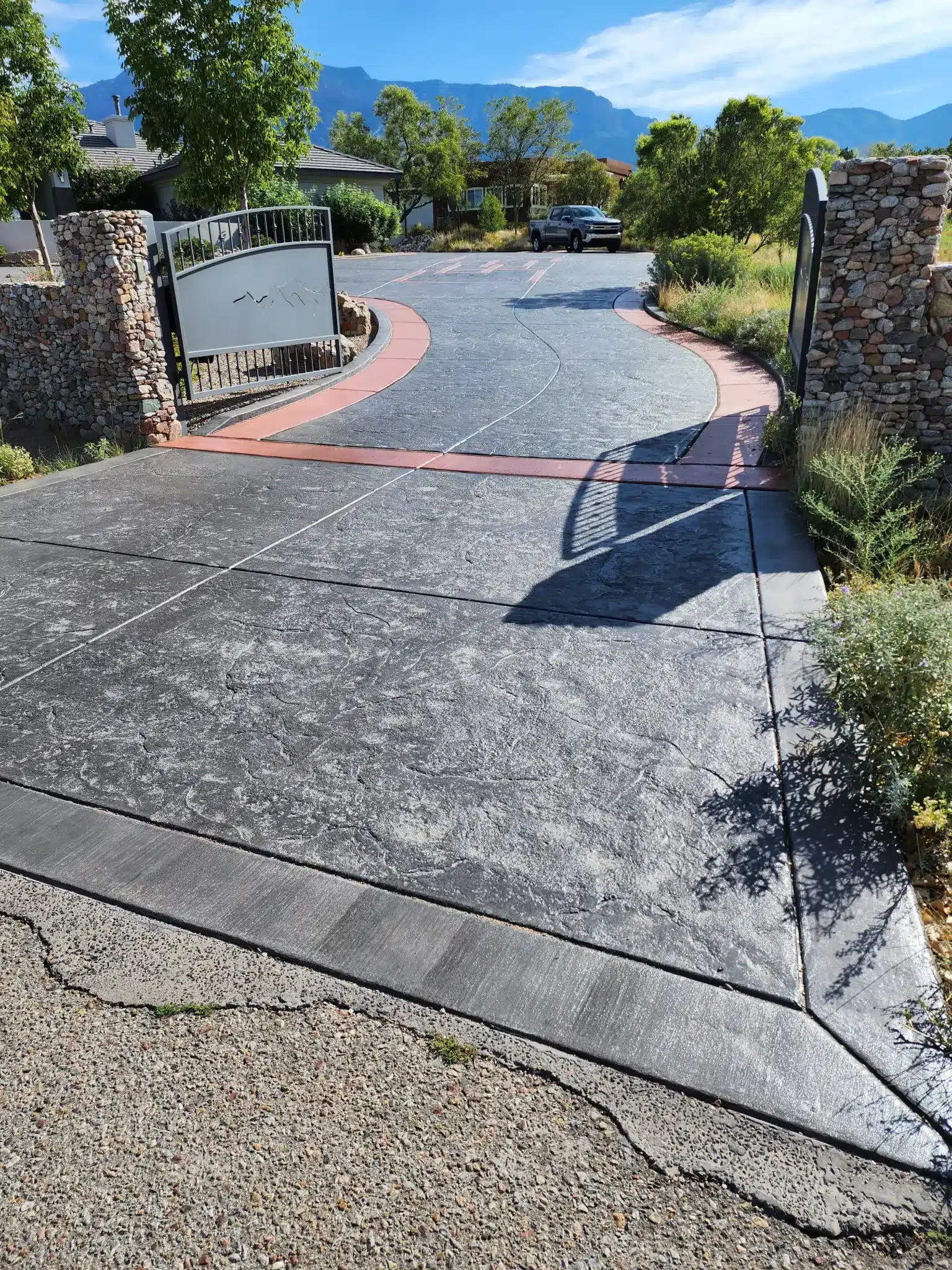
7,800 Sq Ft Stamped Concrete Driveway — Flagstone Pattern with Broom Border
Residential · North Albuquerque Acres · Granite terrain · Dark purple flagstone with red broom borders
7,800
Sq Ft Driveway
5″
Slab Thickness
4,000
PSI Concrete
Purple
Flagstone Field
Red
Broom Border (2′)
5
Days Start to Finish
This North Albuquerque Acres property called for a driveway that made a statement without fighting the home’s Southwest architecture. The homeowners chose a dark purple flagstone stamped field for the full driving surface, framed on both sides by 2-foot red broom finish borders — a combination that reads as intentional and custom rather than an off-the-shelf pattern choice.
The site sits on North Albuquerque Acres’ granite terrain, which meant a lot more dirt grading and compaction work than a standard West Mesa or South Valley lot requires. We poured the full 7,800 square feet at 5 inches thick with heavy-gauge welded wire mesh, properly chaired and elevated to mid-depth rather than left resting on the sub-grade — the reinforcement did its job because it was supported correctly through the pour, not because of the material itself. The full project, from grading through the sealed finish, was completed in five days.
Key specifications: 7,800 sq ft total · 5″ slab thickness · 4,000 PSI concrete · heavy-gauge wire mesh, chaired at mid-depth · dark purple flagstone field with 2′ red broom finish borders · extensive dirt grading and compaction on granite terrain · 5-day completion.
Why the Grading Took Longer Than the Pour Itself
North Albuquerque Acres lots regularly sit on granite-influenced terrain, and this one was no exception. Getting a 7,800 square foot footprint to a consistent, properly compacted grade across granite-heavy ground takes real time and equipment — considerably more than the same footprint would take on flatter, more uniform soil elsewhere in the metro. We spent more calendar time on grading and compaction than on the pour and finish combined, which is the opposite of what a homeowner might expect watching the project from the porch, but it’s exactly where a driveway this size either earns its 30-plus-year lifespan or doesn’t.
Why We Used Chaired Wire Mesh Instead of Rebar or Fiber Here
Heavy-gauge welded wire mesh, properly elevated on chairs at mid-depth, is a legitimate reinforcement choice for a driveway this size and load profile — the criticism you’ll sometimes hear about wire mesh is really a criticism of mesh laid directly on the sub-grade and left unsupported through the pour, where it ends up doing almost nothing. Chaired correctly, heavy-gauge mesh distributes tensile strength across the full slab the way it’s designed to. We match the reinforcement method to the job rather than defaulting to the same approach on every driveway regardless of size or budget.
The Border Detail That Ties the Whole Driveway Together
The 2-foot red broom finish borders running along both edges of the purple flagstone field do more than add color contrast — they define the driveway’s edge cleanly against the surrounding landscaping and give the eye a clear frame for the stamped pattern in the middle. Getting that border consistent across 7,800 square feet meant careful control joint planning at the field-to-border transition, so the two finishes crack independently rather than telegraphing stress into each other over time.
What Five Days Actually Covered
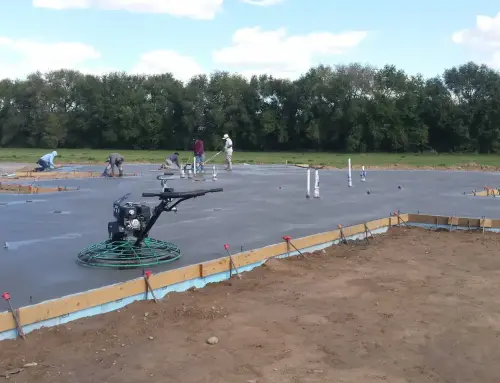
The first two days on this project were almost entirely grading and compaction, given the granite terrain. Day three was forming and reinforcement placement — setting the wire mesh on chairs across the full 7,800 square feet and verifying it stayed elevated through the walk-through before the pour. Day four was the pour itself, worked in sections to manage the stamping window across a surface this large, plus stamping and border finishing. Day five was detailing, joint cutting, and sealing. Compressing that sequence into five days only works because one crew owns every phase — nobody was waiting on a separate excavation company to finish grading before a concrete crew could even show up.
Every Driveway Surface We Install
M&M Concrete — 45+ years — installs every driveway surface type used across the Albuquerque, Rio Rancho, and Santa Fe markets. Here’s the full range.
Every Surface at a Glance
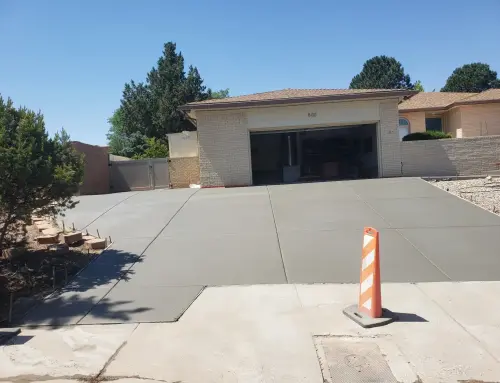
- Standard concrete — The most durable, longest-lived driveway surface available, 30 to 50 years with minimal maintenance.
- Stamped concrete — Flagstone, cobblestone, brick, Saltillo tile, and custom border combinations like the North Albuquerque Acres case study above.
- Decorative concrete — Exposed aggregate, integral color, and scored patterns on the same structural standard as plain concrete.
- Gravel — Cost-effective, permeable, drains well through monsoon season when installed on a properly compacted base.
- Road base & millings — A hard, durable middle ground between gravel and concrete for long rural driveways.
- Dirt driveways — Graded and compacted native material for agricultural and rural properties.
Service Details
Most Requested
🏗️ Standard Concrete Driveway
Poured with rebar or properly chaired mesh, correct thickness, and real sub-grade prep. See our concrete driveways page and our driveway contractors guide.
🎨 Stamped Concrete Driveway
All the durability of standard concrete with a decorative pattern pressed in. See our stamped concrete contractors page and our stamped concrete patios and driveways guide.
✨ Decorative Concrete Driveway
Exposed aggregate, integral color, or scored border patterns poured to the same structural standard as plain concrete. See our driveways and patios guide.
🪨 Gravel Driveway
A permeable, cost-effective surface installed on a properly compacted and excavated base — not dumped on top of dirt.
🛣️ Road Base & Millings
Crushed road base or recycled asphalt millings compacted into a durable surface, popular on long rural driveways.
🚜 Dirt Driveway Grading
Native dirt graded and compacted to shed water and hold its profile under regular traffic, common on rural and agricultural properties.
If your project is replacing a failed surface rather than installing a first driveway, see our concrete driveway replacement guide and our driveway replacement Albuquerque page for that scope specifically. Full tear-out and rebuild of an existing failed driveway is also covered on our concrete demolition and replacement guide.
Matching the Surface to the Property
A new-construction custom home in North Albuquerque Acres calls for a different conversation than a rural access road in Edgewood or a straightforward replacement driveway in a Rio Rancho subdivision. We don’t lead every estimate with concrete by default — a lot of properties are genuinely better served by millings or gravel, and we’ll say so even when concrete would be the more profitable recommendation for us. The goal is a driveway that fits the property and the budget, not the most expensive thing we could sell.
Concrete Finishes & Mix Designs
Every finish in this section goes down on exactly the same structural foundation — same 4,000 PSI baseline, same reinforcement standard, same sub-grade preparation covered earlier in this guide. The finish is a surface decision. The engineering underneath it doesn’t change based on which one you pick.
Every Finish at a Glance
Most Cost-Effective
⬜ Gray Concrete — Broom Finish
Standard broom finish is the baseline — clean, slip-resistant, and the lowest-cost option at the same structural standard as every other finish on this list.
🎨 Colored Concrete
Integral color mixed through the full slab depth, so the tone doesn’t wear off the way a surface stain would over decades of traffic and UV exposure.
💎 Exposed Aggregate
A textured, slip-resistant finish that shows real stone aggregate in the mix — durable and low-maintenance, popular on sloped or high-traction driveways.
🖌️ Stamped Concrete
A pattern pressed into the surface while the concrete is still plastic — the North Albuquerque Acres case study above is a flagstone example. See our stamped concrete contractors page.
✨ Scored & Decorative Patterns
Saw-cut or tooled scoring that creates a tile-like grid or custom geometric pattern without the cost of a full stamped surface.
🖼️ Custom Borders
A contrasting broom, colored, or stamped border framing a different center finish — like the 2-foot red broom borders framing the purple flagstone field in the case study above.
Mix Design Behind Every Finish
The 4,000 PSI air-entrained baseline covered earlier in this guide applies whether the surface finish is plain gray broom or a $20-per-square-foot stamped pattern. What can change by finish is water-cement ratio management during placement — decorative finishes with more surface working time, like stamping or exposed aggregate exposure, need a mix that stays workable slightly longer without sacrificing strength, which is a superplasticizer decision rather than a water-added-on-site shortcut.
Custom Borders — The Detail That Elevates a Standard Driveway
A custom border doesn’t require upgrading the entire driveway to a premium finish. Framing a standard gray field with a colored or stamped border — or the reverse, like the red broom border framing the purple flagstone field on the North Albuquerque Acres case study — gets a custom, intentional look at a fraction of the cost of stamping or coloring the full surface. The control joint planning at the border transition matters here just as much as the visual design, so the two finishes crack independently instead of stressing each other over time.
On a 30 to 50-year surface, the per-year cost difference between plain and premium finishes is small. If curb appeal matters on your property, it’s worth the conversation. Decorative options that connect a driveway to an adjoining patio or walkway are covered on our Rio Rancho driveways and patios guide as well, for anyone planning both surfaces at once.
Stamped Concrete Patterns We Install
We install every major stamped pattern across Albuquerque, Rio Rancho, and Santa Fe, plus fully custom combinations like the dark purple flagstone and red broom border pairing on the case study above.
Most Requested
🪨 Flagstone
Irregular slabs and organic edges that read as natural stone — our most requested pattern across all three markets, and the pattern used on the case study above.
🧱 Ashlar Slate
Clean, rectangular cuts in a staggered layout — more structured than flagstone, popular in North Albuquerque Acres and Sandia Foothills driveways.
🛣️ Cobblestone
A more labor-intensive, tightly detailed layout that gives a driveway the feel of an old European street — distinctive and unlike anything else on the block.
🪵 Wood Plank
Concrete that looks like wood without the warping, rotting, and UV damage real wood suffers in New Mexico’s climate.
🧱 Brick
A durable, timeless pattern that complements traditional and craftsman-style homes and holds up well to vehicle traffic when properly sealed.
🌀 Roman Fan
Curved, radiating stone segments that fan out from a point — a striking pattern for circular drives and entry courtyards, less common but a real showpiece where it fits.
Custom & Combination Patterns
Beyond the standard patterns above, we build fully custom combinations — different patterns in the field versus the border, custom color blends beyond a standard catalog choice, and layouts designed around a specific architectural detail on the home. The North Albuquerque Acres case study is exactly this kind of custom job: a dark purple flagstone field is not a standard catalog color, and pairing it with a red broom border rather than a matching stamped border was a deliberate design choice we worked out with the homeowner before the first form went up. See our stamped concrete patios and driveways guide for more design combinations and pricing.
Gravel, Road Base & Millings — Alternative Surfaces
Not every driveway needs to be concrete. Gravel, road base, and recycled asphalt millings all have a real place in the Albuquerque, Rio Rancho, and Santa Fe markets, especially on longer rural driveways where full concrete isn’t practical or budget-justified.
Gravel
A gravel driveway installed correctly drains monsoon runoff fast and costs significantly less than concrete upfront. The key phrase is “installed correctly” — gravel dumped on uncompacted dirt develops ruts and washouts within a season. We excavate first, compact the sub-grade to 95% Proctor density, add a weed barrier, and bring in the right gravel specification for the actual use.
Road Base & Millings
Recycled asphalt millings and crushed road base sit between gravel and concrete — harder than gravel, handles vehicle traffic better, and costs less than concrete. Millings bind together from residual asphalt binder, especially in New Mexico’s heat, and are a common choice on long rural driveways, agricultural access roads, and equipment paths.
Dirt Driveways
On rural properties throughout Corrales, Edgewood, and the East Mountains, native dirt driveways are common and practical when properly graded — crowned or cross-sloped to shed water, compacted rather than just dragged flat, with drainage swales on longer runs.
Whatever the surface, sub-grade excavation and compaction come first through our ABQ Backhoe & Bobcat Services, not subcontracted and hoped for. For heavy site work beyond driveway scope — parking areas, sidewalks connecting to the driveway, or a larger commercial entry — see our concrete parking lots guide and our concrete sidewalks guide.
Excavation, Grading & Site Prep
Every driveway installation — concrete, gravel, millings, or dirt — starts with excavation and grading, not with the surface material. The North Albuquerque Acres case study above is a good example of how much this step can matter on granite-heavy terrain.
🚜 Dirt Work & Grading
Rough and fine grading ahead of any driveway surface. See our dirt work guide.
🪨 Excavating
Excavation to design elevation across every soil type in the metro, including granite terrain. See our excavating contractors page.
📐 Excavation & Dirt Grading
Fine grading and drainage correction around the finished driveway. See our excavation and dirt grading guide.
🌵 Land Clearing
Brush and vegetation clearing ahead of a new driveway footprint. See our land clearing page.
🗑️ Junk & Debris Removal
Old fencing and construction debris hauled off by the crew already on-site. See our junk and debris removal page.
🔨 Old Surface Removal
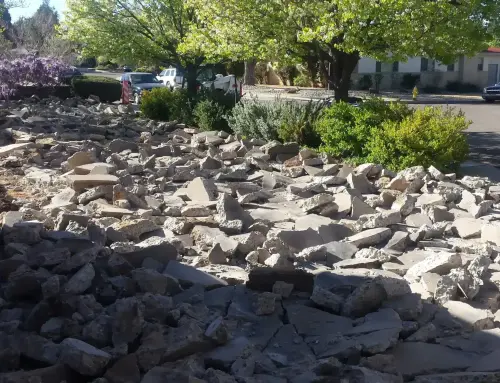
Existing concrete, asphalt, or gravel removed completely before new work begins. See our demolition and removal page and our concrete demolition contractors page.
Every one of these services is part of the broader lineup on our full service concrete contractor Albuquerque page.
Compaction — The Step Every Surface Depends On
COMPACTION STANDARD — 95% PROCTOR DENSITY
❌ UNCOMPACTED SUB-GRADE
〰️ Loose · Voids · Soft spots · No bearing capacity 〰️
Result: Ruts, settling, and cracking within a few seasons — on any surface type
↓ M&M Concrete — In-House Vibratory Compaction — ABQ Backhoe & Bobcat ↓
✅ COMPACTED TO 95% PROCTOR DENSITY
▬▬▬▬ Dense · Uniform · Verified Before Surfacing ▬▬▬▬
Result: Stable bearing layer — concrete, gravel, or millings all hold up long-term
All compaction handled in-house — M&M Concrete / ABQ Backhoe & Bobcat Services — never subcontracted
This standard applies to every surface in this guide, not just concrete — a gravel driveway dumped on uncompacted dirt fails the same way a thin, under-compacted concrete slab does, just faster. On the North Albuquerque Acres case study, this step alone took longer than the pour itself given the granite terrain.
Why We Don’t Sub Out Grading
A driveway contractor who subcontracts excavation is working from whatever compaction level the excavation sub delivers, with no direct control over whether it actually meets 95% Proctor density before the pour. On the North Albuquerque Acres job, running our own grading equipment meant we could spend the extra time granite terrain demanded without negotiating a change order with a separate excavation company or waiting on their schedule to fit us back in. That control over the timeline is one of the practical reasons the whole project came in at five days instead of stretching into two separate weeks.
Concrete Mix & Reinforcement — Matched to the Climate
4,000 PSI is our baseline across Albuquerque, Rio Rancho, and Santa Fe, the same mix used on the North Albuquerque Acres case study above. What sits underneath that baseline changes depending on location and load.
Reinforcement Options
Standard rebar — #4 or #5 on 16 to 18-inch centers, properly chaired at mid-depth — is our default for most residential driveways. Heavy-gauge welded wire mesh, also chaired at mid-depth rather than left resting on the sub-grade, is a legitimate alternative for larger pours like North Albuquerque Acres. Synthetic fiber reinforcement works well for standard-load driveways where three-dimensional crack resistance through the mix makes more sense than a grid. We’ll tell you honestly which approach fits your specific driveway rather than defaulting to whichever is fastest to schedule.
Whatever the material, the same rule applies across all three: reinforcement that isn’t properly elevated during the pour does almost nothing, regardless of whether it’s rebar, mesh, or fiber suspended incorrectly. The chairs and the verification before the pour matter as much as the reinforcement schedule itself.
Air Entrainment & Curing
Air-entrained concrete gives freezing water somewhere to expand into instead of spalling the surface, and we use it on every driveway across all three markets — with Santa Fe’s mix leaning on it more heavily given more frequent freeze-thaw cycling at elevation. Central New Mexico’s dry air works against every pour the same way regardless of city, so we apply curing compound immediately after finishing and schedule pours for early morning whenever the season allows.
Why Reinforcement Isn’t a One-Size Decision
A 400 square foot single-car driveway carrying nothing heavier than a sedan doesn’t need the same reinforcement plan as a 7,800 square foot estate driveway like the North Albuquerque Acres case study, and neither of those needs what an RV pad or heavy equipment access route requires. We spec reinforcement to the actual size and load of the project rather than running one default across every job — that’s part of what keeps a small driveway’s cost reasonable while still giving a large or heavy-use driveway the reinforcement it actually needs to hold up over decades. Driveways leading to a metal building or workshop follow the same load-matching logic covered in more depth on our metal building foundations guide.
Installation Conditions — By City
Age and material aside, where a driveway sits changes the plan before a single truck shows up. Here’s what that looks like city by city.
Albuquerque
Caliche depth and soil type vary lot to lot across the metro, and granite terrain in areas like North Albuquerque Acres and the Sandia Foothills changes the grading and compaction plan significantly compared to flatter parts of town. We assess soil conditions on every site visit rather than quoting off a drive-by look. A driveway on the West Mesa’s sandy loam and a driveway on Sandia Foothills granite can sit five miles apart and call for genuinely different excavation approaches.
Rio Rancho
Rio Rancho’s West Mesa soil is predominantly sandy, which drains well but compacts differently than Albuquerque’s mixed soil types. Getting proper compaction here often means more moisture conditioning and additional passes than a comparable Albuquerque site needs. Rio Rancho’s newer, more uniform subdivisions also mean we’re more often working on a lot with a known development history rather than the layered, unpredictable fill and native soil combinations common in Albuquerque’s older neighborhoods.
Santa Fe
Santa Fe’s higher elevation brings deeper frost depth and considerably more freeze-thaw cycling through a New Mexico winter. Mix design and control joint spacing both get adjusted specifically for that colder, harsher cycle rather than using an Albuquerque-standard spec. Scheduling also shifts in Santa Fe — the installation window that works fine for Albuquerque or Rio Rancho year-round narrows earlier in the fall and opens later in the spring at that elevation.
For a deeper dive into the material-by-material breakdown — concrete, gravel, road base, and dirt — specific to Albuquerque conditions, see our driveway installation Albuquerque guide. If your project involves a foundation or slab alongside the driveway, our concrete slabs and foundations guide covers that combined scope.
One Crew — Start to Finish
A driveway installation usually means excavation, grading, compaction, forming, and the pour — phases that go sideways when separate contractors handle each one without talking to each other.
M&M Concrete and ABQ Backhoe & Bobcat Services handle every phase with our own crew and equipment. On the North Albuquerque Acres case study above, that meant extensive granite-terrain grading through the sealed stamped finish in five days — one company accountable for the entire outcome.
Areas We Serve
We install driveways throughout central New Mexico. Each area’s soil and climate shape the installation plan, as covered above — here’s where we work.
- Albuquerque — All neighborhoods. See our concrete contractors in Albuquerque page and the residential concrete contractors in Albuquerque guide.
- North Albuquerque Acres & Sandia Foothills — Custom home driveways on granite terrain, like the case study above.
- Corrales & North Valley — Gravel and millings driveways on agricultural properties. See our concrete contractors in Corrales page.
- Rio Rancho — Residential concrete driveways throughout Rio Rancho’s development areas. See our Rio Rancho concrete services page and our concrete contractors in Rio Rancho guide.
- Santa Fe — Freeze-thaw engineered driveways at elevation. See our Santa Fe concrete contractors page and our concrete contractors Santa Fe NM guide.
- Edgewood & East Mountains — Rural driveway grading, road base and millings on rocky terrain. See our concrete contractors in Edgewood page.
- Placitas & Bernalillo — Rural and custom estate driveways throughout Sandoval County. See our concrete contractors Placitas page.
- Los Lunas & Valencia County — Concrete and gravel driveways throughout Valencia County. See our Los Lunas concrete contractors page.
If you’re comparing companies, our concrete contractor in Albuquerque NM guide and our best concrete contractors in Albuquerque and Santa Fe guide cover what to look for beyond a low bid. Driveways poured alongside a home foundation are covered on our concrete foundations in Albuquerque guide, and patios installed as part of the same project are covered on our concrete patios in Albuquerque and Rio Rancho guide. Commercial or shared-access driveway installations are covered on our commercial concrete contractors page.
Concrete Driveway Installations Pricing
Driveway pricing depends on surface type, size, sub-grade conditions, and grading complexity — the North Albuquerque Acres case study above required significantly more grading time than a flatter lot would.
| Driveway Type | Specs | Est. / Sq Ft |
|---|---|---|
| Standard concrete driveway | 4–5″ thick, reinforced, broom finish | $7 – $11 |
| Thick concrete — heavy vehicle use | 6″ thick, #5 rebar | $9 – $14 |
| Stamped concrete driveway | Pattern + color, sealed (like case study above) | $12 – $20 |
| Decorative concrete driveway | Exposed aggregate, color, or border | $10 – $17 |
| Gravel driveway installation | Excavation, compacted base, surface gravel | $3 – $6 |
| Road base or millings driveway | Excavation, compacted base, surface material | $2 – $5 |
Every project receives a written estimate after an on-site evaluation. For full pricing across every service we offer, see our concrete contractor costs guide. Call (505) 550-0418 to schedule a free estimate.
Frequently Asked Questions
How is Santa Fe driveway installation different from Albuquerque?
Santa Fe’s higher elevation means deeper frost depth and more frequent freeze-thaw cycling. We lean more heavily on air entrainment and hold tighter control joint spacing there than we typically need in Albuquerque or Rio Rancho.
Is heavy-gauge wire mesh a good reinforcement choice?
Properly chaired and elevated at mid-depth, yes — that’s what we used on the 7,800 square foot North Albuquerque Acres case study above. The issue with wire mesh in general is when it’s laid directly on the sub-grade and left unsupported through the pour, where it ends up providing almost no structural benefit.
Why did the North Albuquerque Acres driveway take extra time on grading?
North Albuquerque Acres sits on granite-influenced terrain, which takes considerably more grading and compaction work than flatter, more uniform soil elsewhere in the metro. Getting that step right is what gives a driveway this size its long-term lifespan.
Can a driveway installation be combined with a foundation or patio pour?
Yes, and it’s often more efficient to schedule them together. See our concrete slabs and foundations guide for how we typically sequence combined projects.
What’s the difference between this guide and your driveway installation Albuquerque page?
This page covers the tri-city comparison — how installation changes across Albuquerque, Rio Rancho, and Santa Fe — plus the North Albuquerque Acres stamped concrete case study. If you want the material-by-material breakdown specific to Albuquerque alone, see the link near the top of this guide.
Do you offer free estimates for driveway installation?
Always. We come out, assess your site and soil conditions, walk through material and finish options, and give you a written quote covering the complete scope.
How do I decide between concrete, stamped concrete, gravel, and millings for my driveway?
It comes down to budget, traffic, and how long you want the surface to last without touching it again. Concrete costs the most upfront and lasts the longest with the least maintenance. Stamped concrete adds decorative value at a moderate premium over plain concrete. Millings and road base cost less and handle regular vehicle traffic reasonably well, especially on longer rural driveways. Gravel costs the least and drains well but needs periodic top-dressing over time. We’ll walk through your specific situation honestly rather than push whichever option is most profitable for us.
Does the reinforcement type affect the price?
Somewhat, though it’s usually a smaller factor than slab thickness and total square footage. Standard rebar, heavy-gauge chaired mesh, and synthetic fiber all fall in a similar cost range for a given project size — the bigger price driver is matching the right reinforcement to the actual load and size of the driveway, which is a decision we make together with you during the estimate.
How far in advance should I schedule a driveway installation?
Lead times vary by season and current workload, and Santa Fe’s shorter installation window at elevation means scheduling early matters more there than in Albuquerque or Rio Rancho. Contacting us early helps secure a place on the schedule, especially for larger projects like the North Albuquerque Acres case study above.
Are you licensed and insured across all three markets?
Yes. We’re fully licensed, bonded, and insured to work throughout New Mexico, not just within Albuquerque city limits — the same coverage applies whether the project is in Rio Rancho, Santa Fe, or anywhere else in central New Mexico we serve.
Get a Free Concrete Driveway Installation Estimate
Whether your project is in Albuquerque, Rio Rancho, or Santa Fe, the standard is the same — proper grading, correct mix design, reinforcement matched to the load, and a finish built to last decades. Read more about M&M Concrete before you call, or browse our full stamped concrete options if a decorative driveway like the case study above is on your mind.
Concrete Driveway Installations — Albuquerque · Rio Rancho · Santa Fe
M&M Concrete — 45+ Years & Still Pouring
Concrete · Stamped · Decorative · Gravel · Road Base & Millings · Dirt Driveways
Locally owned. Family operated. Licensed, bonded & insured.
abqconcrete.com | (505) 550-0418 | Serving Albuquerque, Rio Rancho, Santa Fe, Los Lunas, Edgewood, Corrales, Placitas & all of Central New Mexico